Read The
Current Issue


Bonds That Endure
Being a ski or snowboard instructor at JHMR is more than a job, and many do it for decades.
// By Dina Mishev
// photography by KATHRYN ZIESIG
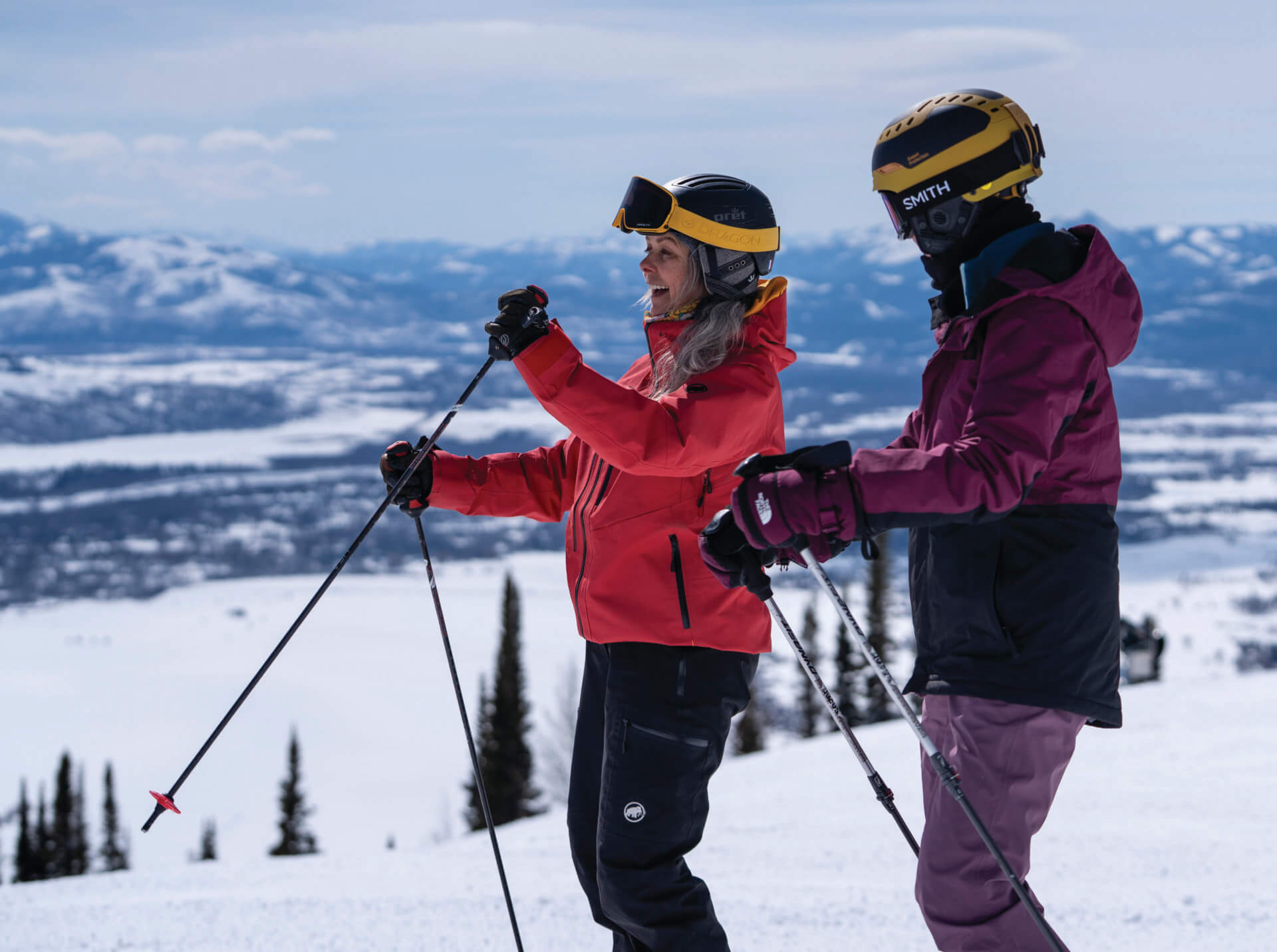
In 1982, Lexey Wauters was one of 14 new ski instructors hired at Jackson Hole. Today, more than four decades later, five of these 14, including Wauters, still work at Jackson Hole Mountain Resort’s Mountain Sports School. “And some of the people that were in my class that don’t work at the resort anymore are still some of my closest friends,” says Wauters, who evolved from instructing to Mountain Sports School management during the 2002–2003 season and today is MSS’s assistant director. “Mountain Sports School bonds endure. Just today I told a new recruit class, ‘Look around at the people in this room. You don’t know it yet, but they are going to become a huge part of your life. Your future spouse, best friends, and bridesmaids are sitting in this room.’ It sounds cliché, but it is alarmingly accurate.”
Caroline Evans Manley, whose first season at MSS was 2004, says, “The culture is very strong, and the people I work with are so talented and smart, and I’m constantly learning from them. We all take care of each other. There are so many instructors here that have been here for such a long time. I don’t think other resorts have that.”
Wauters agrees. “Something that I’ve always been struck by when I’ve traveled to other ski areas to work as a clinician or examiner, is that there is this crazy pride at being a ski instructor from JHMR. It is so evident,” she says. “It is hard to live here and hard to ski here. And if you’re a JHMR instructor, you know you’ve done this hard thing and made it work, and there is something recognizable about that.”
For the first several decades of its existence, when JHMR was still Jackson Hole Ski Corp and Pepi Stiegler, an Austrian who won a gold medal in the slalom at the 1964 Olympics in Squaw Valley (now Palisades Tahoe), was director of the ski school, it was even harder to be a Jackson Hole ski instructor. “Into the 1990s, we were still selling the good, old fashioned ‘ski week,’” Wauters says. “Guests skied with a group. If someone wanted a private lesson, they were one-hour long. Maybe there were a few instructors actually making a living when I started, but everyone I knew all had second jobs—at restaurants or hotels—to help pay the rent.”
But this had changed by the time Manley started (in the early ‘00s). Gone were one-hour private lessons; in were by half- and full-day private lessons, which are more lucrative for instructors, and in which instructors often skied with the same clients for several days. Manley says, “When I was a newbie, I saw instructors that worked every day, were happy, had great relationships with guests and clients—it was very clear that if you put in the time, it was going to pay you back.”
Christina Cartier, who started at MSS in 2001, says, “Having worked as a nurse, I realize teaching skiing is not life-saving work, but it adds value to someone’s holiday and the possibilities in life. JHMR’s whole motto of creating memories, there is truth to that.”
We got five long-time JHMR MSS instructors to share their experiences and why (and how) they’ve made teaching skiing or snowboarding their life’s work.
Caroline Evans Manley
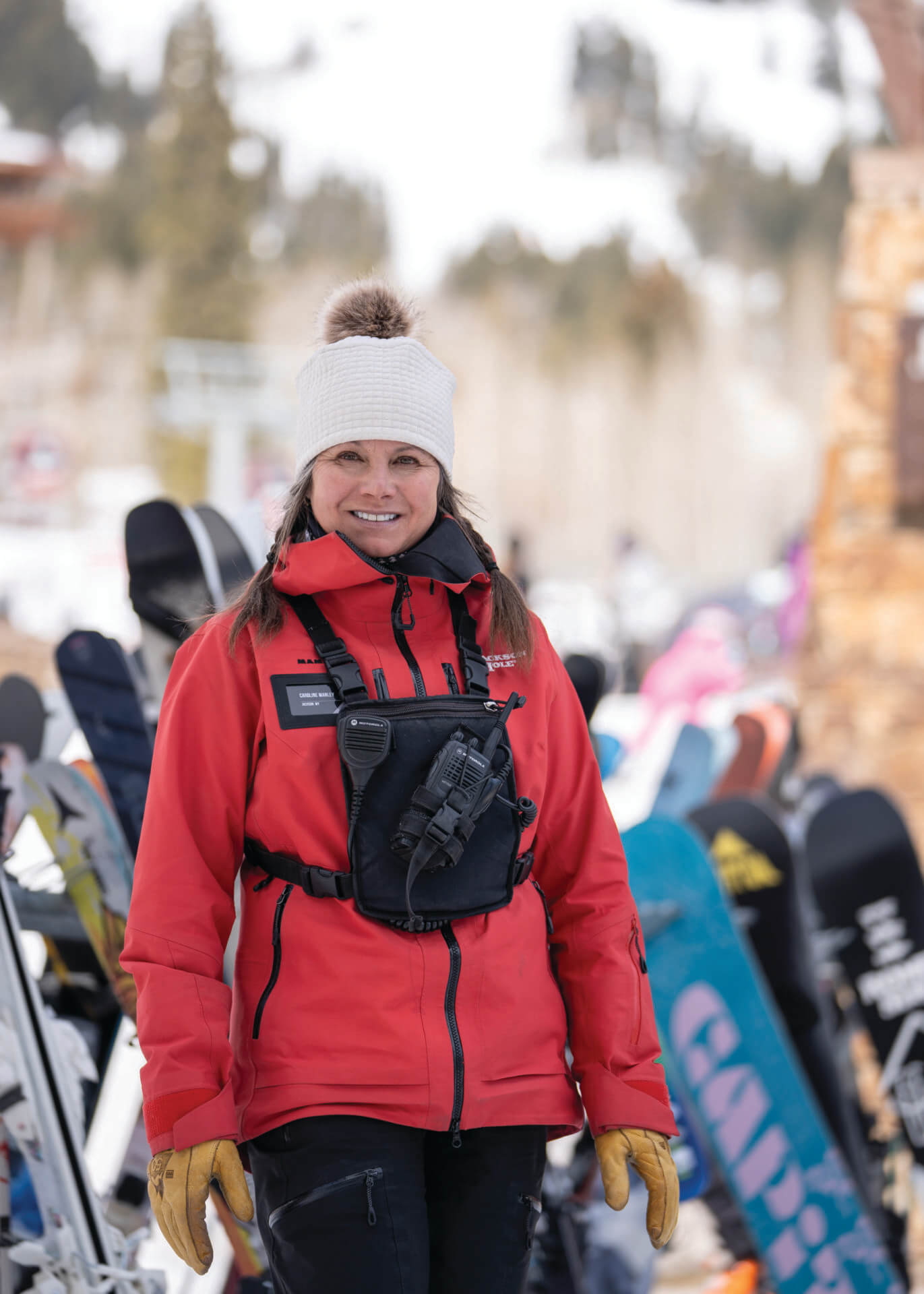
Caroline Evans Manley arrived in Jackson Hole in the fall of 1988, when fires were still burning Yellowstone National Park (36 percent of the park was burned before snow extinguished the fires later that fall). “I pulled in here and couldn’t even seen anything because the smoke was so thick, and there was ash on everything,” she says. “And I didn’t even have housing. I was camping along the river.”
Manley camped through the smoke and ash, but once it got winter-cold, she found a place to live and got a job working in the JHMR ticket office. “I wanted a free pass,” she says. That first winter, Manley, who says she grew up as a “recreational skier” on the slopes of New York’s Hunter Mountain, skied as much as possible. “And it wasn’t enough.”
She continued to work on and off for JHMR in different capacities—the adaptive program, ticket offices—and “skiing was always the backdrop. That was my motivation to be here.” It wasn’t until she started a family that Manley wanted to do something that was more of a career. I saw that teaching at MSS offered a pathway, and my two girls would get ski passes and I would have access to Kids Ranch and locals programs.”
“The longevity of employees isn’t just at MSS, but also in lift ops and ski patrol and other departments. There is something soothing and amazing about this.”
—Caroline Evans Manley
In 2004, Manley went through a three-day MSS instructor tryout. She passed, and discovered she loved teaching. “I was hooked,” she says. “It was very clear that if you did the training, the mentorship, and the culture of the MSS, you could really make a go of it. Before I knew it, I was moving through the certification process and getting client referrals.” Within a few seasons, Manley was working as much as she wanted to, and her daughters, both now in their late 20s, were becoming great skiers. “I put in the time and it was awesome.”
But it wasn’t easy. “Skiing came easier to me than the teaching,” Manley says. “I really had to dig in deep to get through the certifications. Out with clients, I’d have these moments of ‘I’ve got this’ and moments that I didn’t, all in the same day.” She feels like she really came into her own as an instructor once she started coaching the resort’s multi-day Steep and Deep Camp and Women’s Camp. “I’d have four days to build confidence in my skiers and make connections with them,” she says. “By the end of a camp, I felt like I had made an impact and people had really grown.”
Manley taught for almost 20 years and then transitioned into MSS management. “Passing long-time clients on to other instructors was difficult, but it was absolutely the right move for me,” she says. “Now I feel like all of the jobs I’ve had here have given me a big base of understanding of how MSS runs. The education never stops!”
Christina Cartier
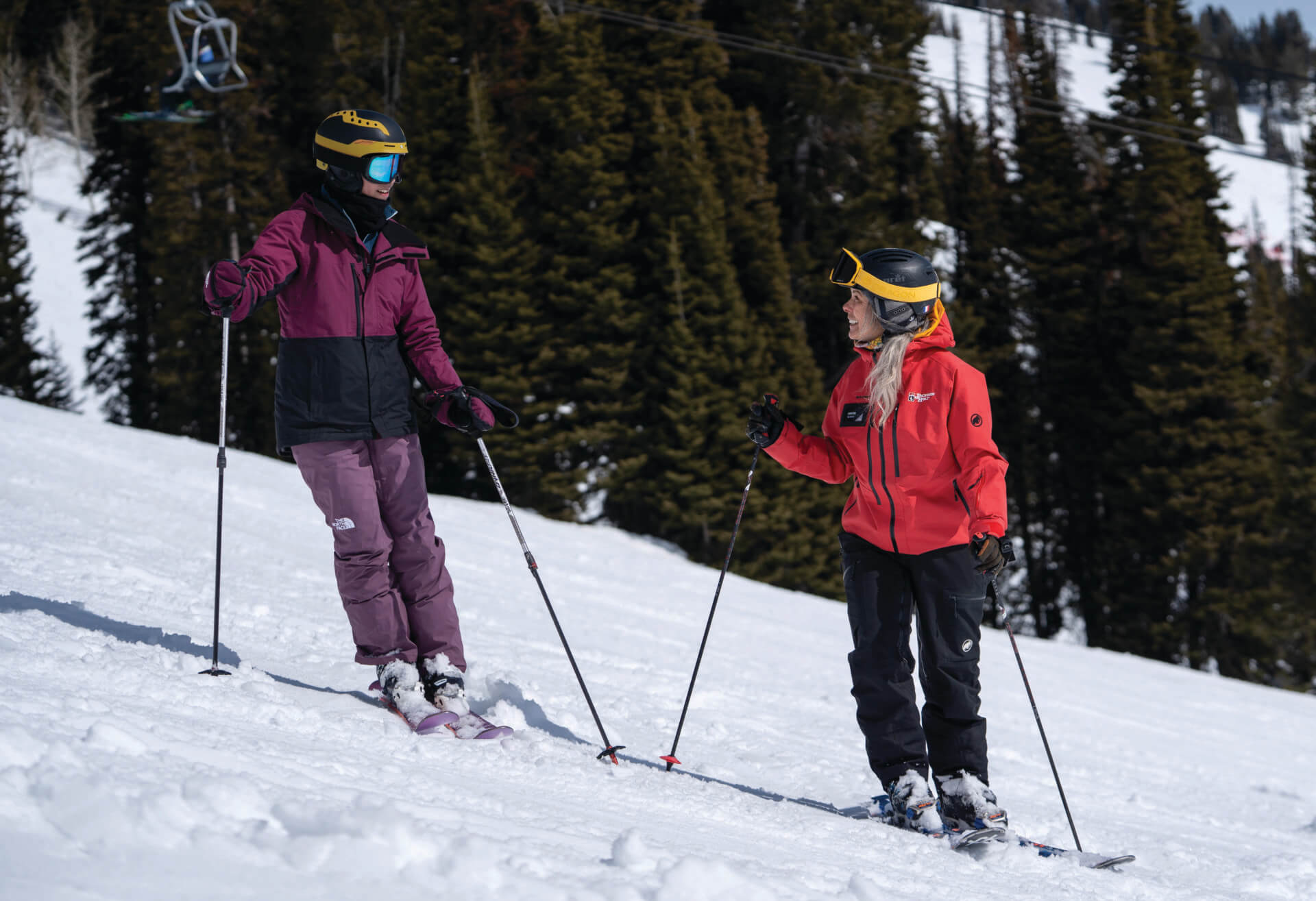
Although she grew up in Europe, Christina Cartier subscribed to U.S. ski magazines. “Jackson Hole kept popping up in them,” she says. “I got it in my head that it was a place I needed to check out.” Cartier moved to the U.S. with her family in 1979, when she was 10, but didn’t make it to Jackson Hole until she was in her 20s. “We’d take family ski trips—we’d visit a different state so we’d get to know the country—but never came to Jackson Hole. We’d fly into big cities and then go ski nearby,” she says.
When Cartier finally made it to Jackson Hole, she says, “I fell in love with the mountain like so many others.” It took her almost another decade to move here, though. In 2001, Cartier’s first job at JHMR was in the Nordic skiing arm of MSS. She started at the Nordic Center’s front desk, and then taught telemark and cross-country skiing, and, since JHMR had permits to do guided tours in Grand Teton National Park, also led those. The following year, Cartier started transitioning to teaching alpine skiing but says she kept a foot in both locker rooms for a couple of years.
“I love teaching and helping the skier that wants to move past the groomers and start tackling steeper slopes, off-piste, and trees. That is pretty satisfying. Their sense of accomplishment and wonder tends to manifest when they reach that point.”
—Christina Cartier
She likes alpine instructing because every day is different. “The guests change and so do the conditions on the mountain—it’s never the same, which keeps it fresh,” she says. “And also challenging. It is a puzzle of figuring out what will help each guest feel like they had the best day on the mountain and then meeting them at that place.”
Coming to Jackson Hole having never before taught skiing, Cartier says MSS’s coaching for instructors is incredible. “There is amazing training here for the instructors that seek it out. I know instructors from other resorts come here to get coaching from our team of coaches.” But not everything that makes a great ski instructor is teachable. “People skills are very important, and you have to intrinsically have a passion for helping people enjoy the sport.”
Steve Martin
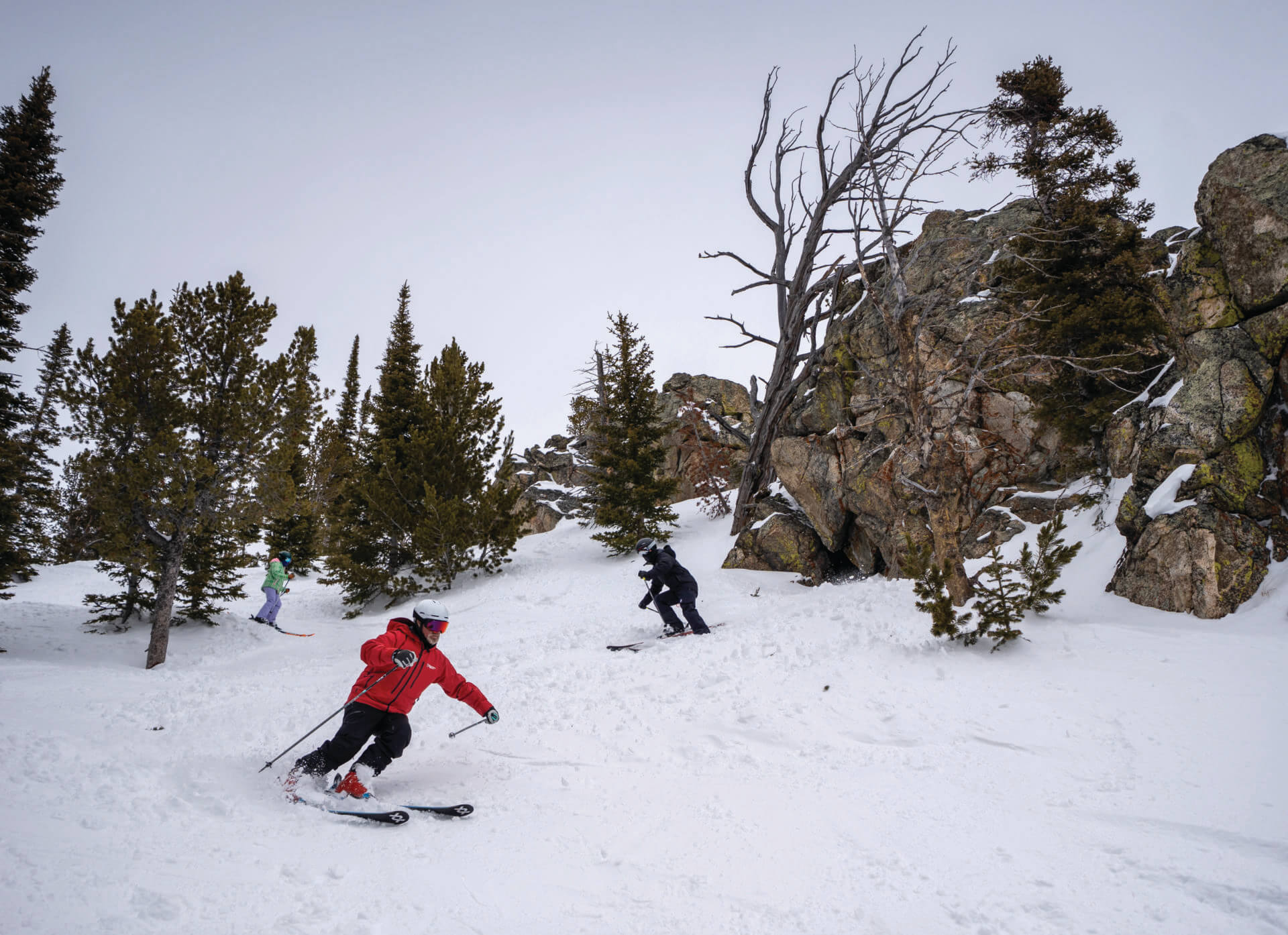
Steve Martin started teaching skiing at JHMR in 1981. “There were maybe 35–40 instructors,” he says. “A lot of people wanted the free ski pass, and being an instructor meant a lot, even if in those days there wasn’t a lot of business. There were weeks I didn’t make enough money to buy food.” Thankfully, Martin taught a lot of kids, and their lessons came with lunch. If he saw that a kid wasn’t going to finish their grilled cheese, he’d ask them if he could have it. “Thanks to the kids, I didn’t starve in the 80s,” he says.
But the food wasn’t his favorite part of teaching kids. “The kids and their parents might have thought that they needed me, but I needed them a lot more. Taking kids out for the day, it wasn’t a day of teaching, but it was a day to go on an adventure. When you’re with these little cartoon characters, they will fix your problems.”
“I’d load up on chocolate gold coins and go out on the mountain with [kids] and say, ‘let’s go look for treasure today!’ It didn’t matter what their ability was, whether we were skiing runs like Pooh-Bear, Ranger, or Toilet Bowl, I always made sure we found treasure.”
—Steve Martin
And Martin says teaching kids made him a better instructor. “To be able to effectively communicate a lesson to little people—when I could convey ideas that mentors like Victor Girden, Earnie Anderson, and Pepi Stiegler taught me, to three- and four-year-olds, that is when I felt like I became a master instructor as opposed to an ego instructor.”
Martin spent his earliest years teaching at JHMR with kids, then branched out to teaching adults, came back to teaching kids, and, since turning 60, exclusively does private lessons. “I just physically couldn’t do Kids Ranch any more,” he says wistfully. “I had to go to bigger people.” But these “bigger people” now include skiers he taught as kids, and also their kids. “I have a couple of families where I’ve taught three generations. While [Mountain Sports School] grew and it became a place instructors could make money, the memories are the gold of my life.”
Tom Bennett
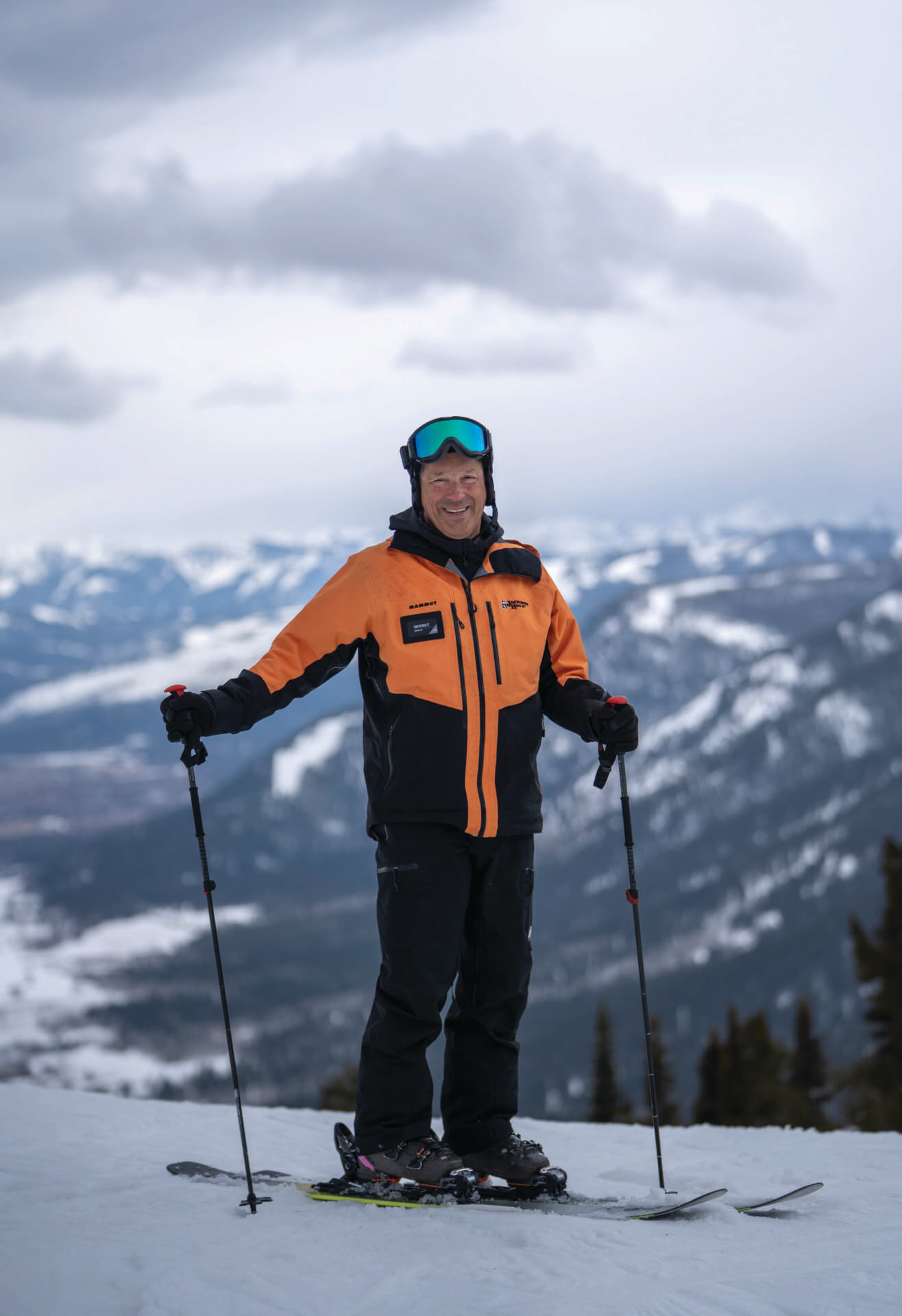
Taking a year off between his junior and senior years at Vassar College, where he was studying biochemistry, Tom Bennett taught skiing at Snow King. After earning his degree in 1986, Bennett came back to Jackson Hole and wanted to teach at JHMR. At that time, the tryouts lasted four days and included skiing with Pepi Stiegler, the founding instructor/director of the ski school. “It was very competitive and macho. About 50 people applied and they hired 10 of us,” Bennett says.
“I really took to teaching,” he says. “I started thinking that it could be a career almost right away. You need to be lucky to make it as a ski instructor, but luck is the combination of preparation and opportunity.” Bennett earned his full instructor certification (today’s equivalent of Level 3) from PSIA his third season, the winter of 1988–1989. He quickly learned about his teaching style: “I didn’t care how good of a skier a client was. I just wanted them to have fun.”
“To this day, many of my best friends are some of my clients.”
—Tom Bennett
In 1998, JHMR opened its backcountry gates, and Bennett, who had been climbing and skiing big lines in the Tetons since his arrival in the valley, transitioned from teaching to guiding. “I was a huge backcountry skier and knew I wanted to be a part of that,” he says. Today, he has backcountry clients that he’s been skiing with for 20-plus years and, thanks to connections he’s made with other guides, has had the opportunity to guide all over the world, from the Alps to heli-skiing in Alaska and Chile. (In addition to guiding for JHMR, Bennett is also an Exum Climbing Guide.) “I am forever grateful for the opportunities I’ve had. Guiding has been so good to me.”
A blue-sky powder day in 2011 almost ended Bennett’s career though. He hit a rock in Rock Springs, a backcountry area south of JHMR, broke his leg, had six surgeries, and was on crutches for 15 months. “The doctors weren’t talking about whether I’d ski again, but whether I’d walk again,” Bennett says. “That time made me really think about what was important. I was staring down the barrel of not ever skiing again. Now I’m more appreciative of every day I get on skis and with clients.”
Mike McGee
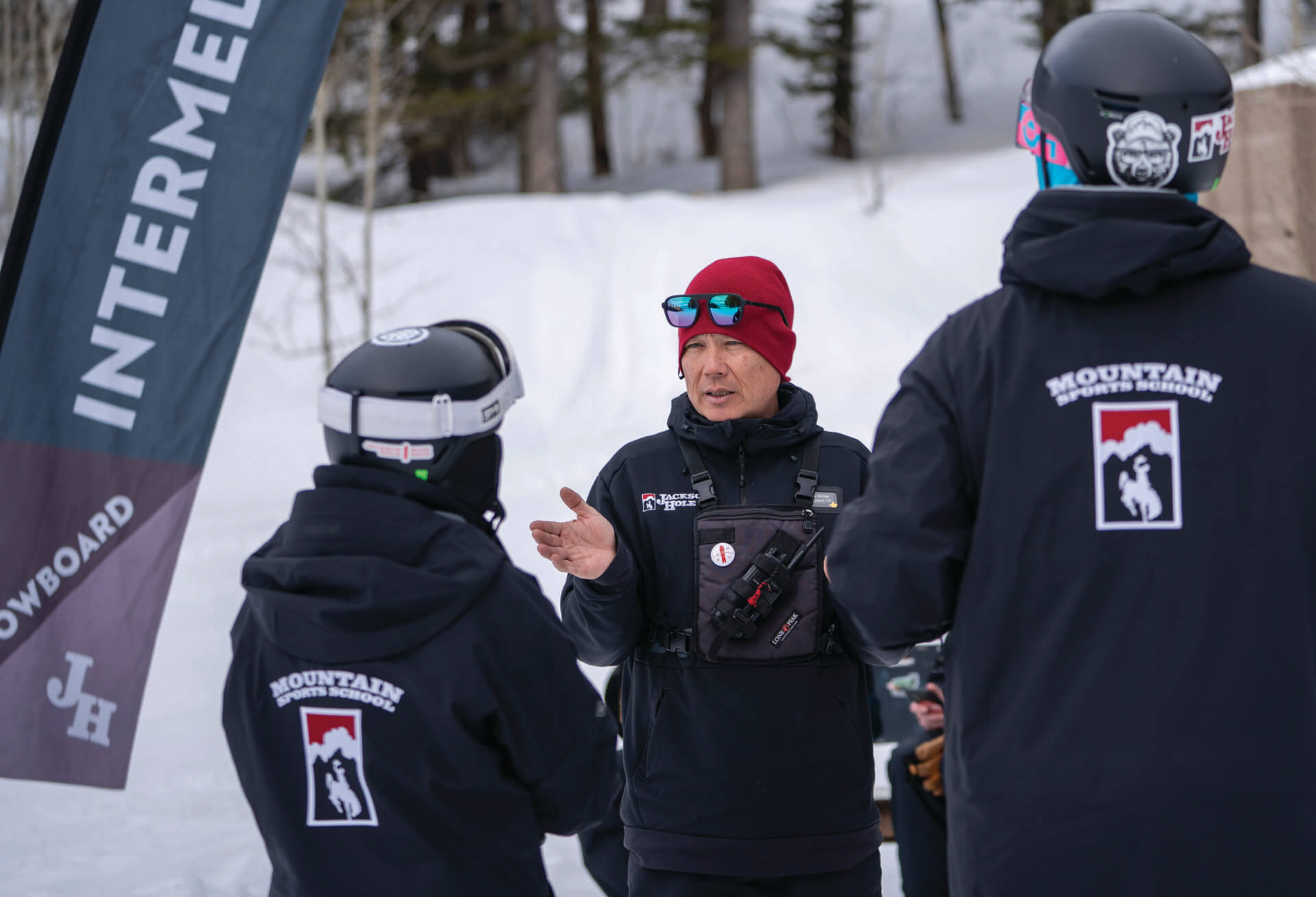
The first time Mike McGee saw snow was also the first time he tried snowboarding. It was 1989, and McGee was 18. “I grew up skateboarding and surfing in Southern California,” he says. Skating friends that had already gotten into the then-new sport of snowboarding took him to Mountain High, a resort about 90 minutes northeast of downtown L.A. “They took me to the top and left me there,” McGee says. “I’d been skating since I was five, so I got it, and got pretty hooked on it.”
Within several years, McGee evolved into snowboard mountaineering—climbing technical routes and then descending them via snowboard. He spent five years in Seattle honing these skills and then “decided the Tetons were where I needed to go.” It was 2000.
“There were many times I thought I had to move on from teaching so I could get a ‘real job’ and make more money, but it was hard to give up something that creates so much stoke.”
—Mike McGee
McGee tried out for JHMR’s snowboard school so that he’d get a pass and also to become a better snowboarder himself. “If you teach people to snowboard, you become better yourself,” he says. McGee did become better, and also fell in love with the job. “I found that I love teaching people how to snowboard. Teaching someone else how to snowboard allowed me to relive the stoke of my first times.”
Each year, McGee sought out more of the certifications that you need to make a career as a snowboard instructor. “It led to better lessons and clients.” It also eventually led to him transitioning from teaching clients to teaching other instructors. “What I enjoy most now is passing on my knowledge and what I’ve learned to new instructors and watching them succeed,” he says. Since 2016, he has been on the Intermountain region snowboard education staff of the American Association of Snowboard Instructors, although McGee still finds time to ride with long-time clients when they’re in town. “But I don’t teach them anymore,” he says. “Now we’re out on the mountain as friends.” JH
Total Number of Jackson Hole instructors in:
Late 1970s: 45
1980: 60
1990: 150
2000: 290
2010: 470
2020: 600+