Read The
Current Issue

The Forest Phantom of the Greater Yellowstone Ecosystem
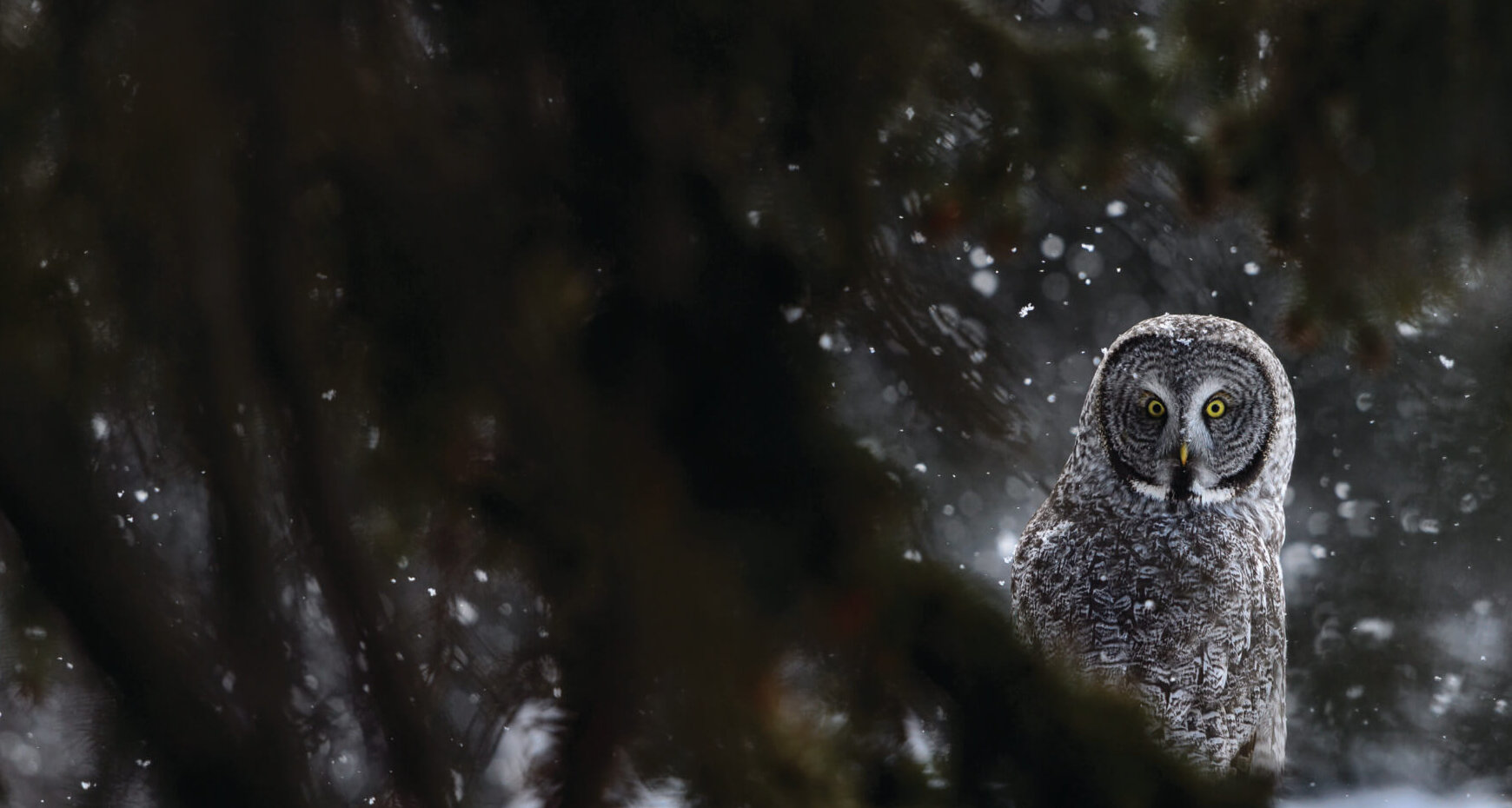
Local resident and PhD scientist Katherine Gura has devoted much of her career to understanding the great gray owl, whose survival along the southern extent of its range might depend on how climate change influences Jackson Hole’s snowpack.
//By Mike Koshmrl

The sucking sound a boot makes coming off mud accompanied each of ecologist Katherine Gura’s steps through a wet meadow in the Shoshone National Forest. It wasn’t the only sucking on the scene. Mosquitos were constant companions.
But Gura was unfazed by the conditions. The thirtysomething ecologist was in her happy place: looking for great gray owls. She was surveying for the vole-eating raptors on the very edge of where they occur in the Rocky Mountains—near the tip of the Wind River Range—in an area that, to her eye, contained habitat that was just right.
“These are beautiful meadows for great grays,” Gura said during the backcountry outing last summer. “As soon as I saw this, it made sense to me that they’re here.” The wet, grassy opening in the timber that drew Gura south from home was located within the suspected territory of the southernmost known great gray owl pair in the entire Greater Yellowstone Ecosystem. The birds came onto the radar when a Wyoming Game & Fish Department biologist, Frank Stetler, stumbled upon them while out hiking in 2023. Two years later, Gura wanted to see for herself, so she set aside a weekend to drive to Lander and check it out. Meticulously searching a forest for great grays—with the mosquitoes, mud, all of it—is what she likes to do. “Sometimes we’re doing analyses, things like that, and it’s not the most fun,” Gura says, referring to her trusty field companion, a mixed-breed pup named Willet. “This is the fun stuff.”
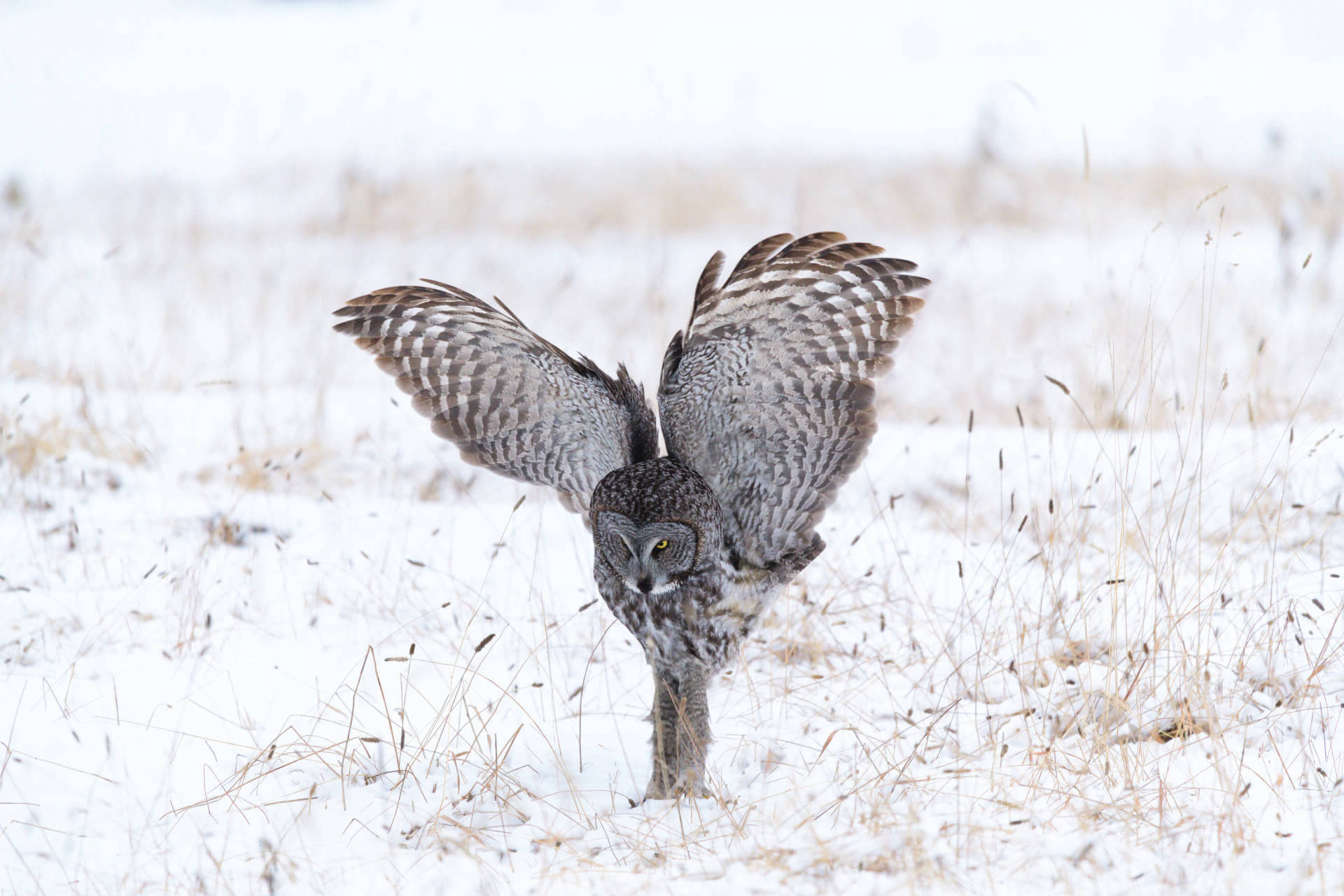
Gura’s fun in the field underlies a devotion to better understanding Strix nebulosa, or great gray owls. It’s a species she’s been studying for a dozen years, dating back to when she was working as a technician for Craighead Beringia South. As the years passed, she picked up a PhD from the University of Wyoming while on staff at Teton Raptor Center, a Wilson-based rehabilitation and research center. Today, she’s a research scientist for Colorado State University. One constant of her professional ascension is the subject of her scientific inquiry: great grays. In the bird-watching world, they are iconic: mysterious, charismatic, and the tallest (from the tip of their tail to the top of their head) owls in the world. Although widespread in Canada and Alaska’s boreal forest, they’re less common—and their existence more tenuous—elsewhere in the United States. “Audubon came out with a prediction that, based on predicted environmental change, we’re not going to have great grays in the Lower 48 by 2060,” Gura says.
Gura’s work is the only long-term study of great gray owls in the Greater YellowstoneEcosystem, which is the most southern nesting population of the species that is known.
Gura’s science has helped shine a light on a factor that could contribute to great gray owls’ struggles. “It is the only long-term study in the Greater Yellowstone Ecosystem,” says Susan Patla, a retired nongame-bird biologist for Wyoming Game & Fish. “It’s also the most southern nesting population that we know of. We’re in a period of climate warming, and this is a boreal species. It makes her study really important.”
Going into the Teton Raptor Center’s great gray project, very little was known about the owls’ basic ecology. The size of their territories was a mystery. The owls’ winter whereabouts were often unknown. Those pictures are now much clearer, thanks to the years of GPS data Gura and her colleagues have amassed. A territory is about 1.5 to 2 miles in diameter. During the winters, resident owls—especially during crusty snow years—are often out on “wanders” in the region. “Just to give one example, I had a bird that was occupying southern Yellowstone National Park, kind of around the Heart Lake area,” Gura says. “In November, it went all the way down to the Green River Lakes area near Pinedale. It spent about six weeks wandering down there and then went all the way back up to southern Yellowstone to spend the rest of the winter, which was just fascinating.”
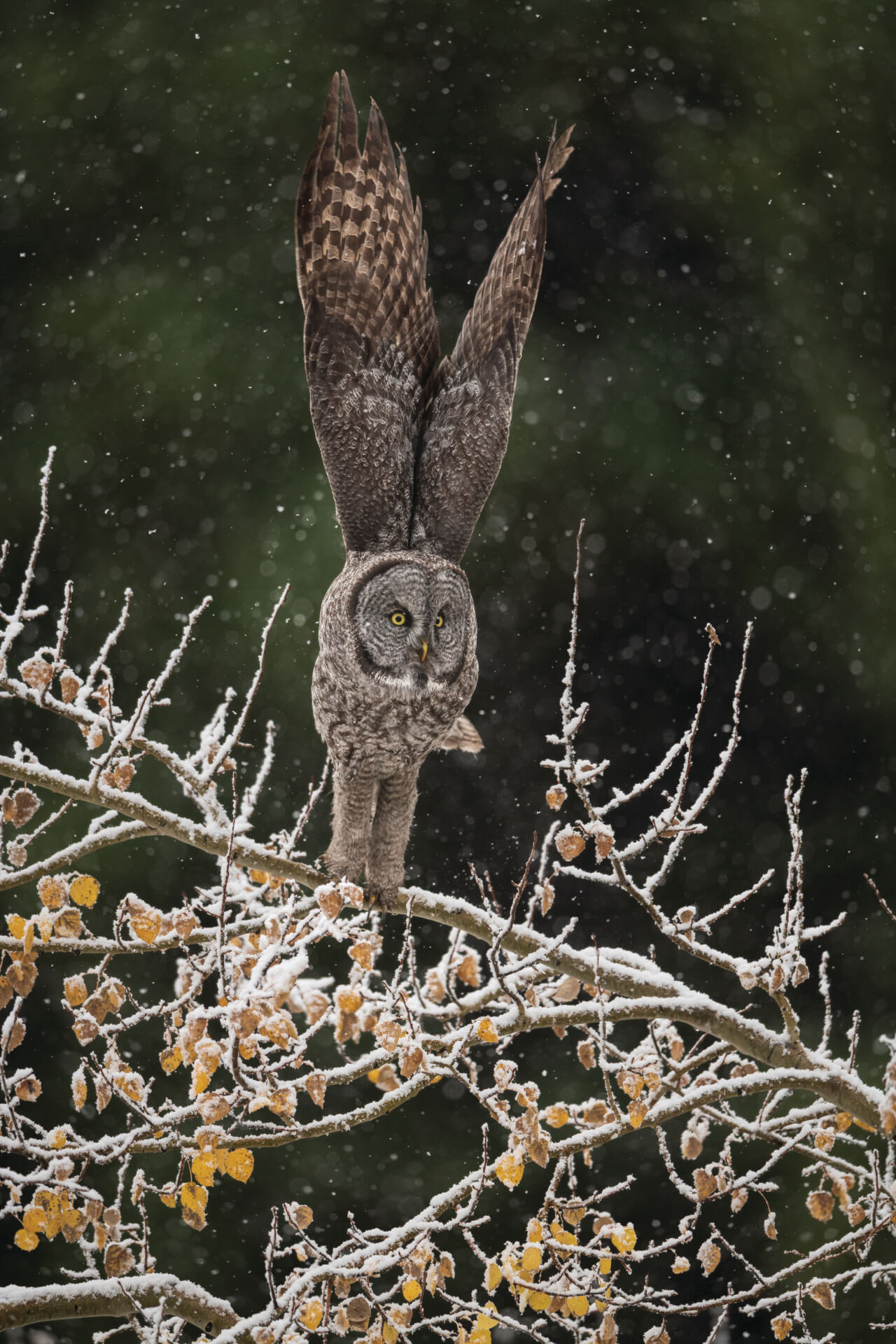
Gura’s put her finger on one contributing factor to the seasonal flyabouts, which almost always end in the great grays returning to their home territory. “We’re having more and more rain events during the winter,” she says. “This past winter, we had five different significant rain-on-snow events that created ice crusts. For an owl that needs to punch through the snow to access its food, those ice crusts are going to be really detrimental,” she says. The need to fly long distances to eat and stay alive, which is happening with increasing frequency, is one piece of a puzzle that ecologists are trying to solve to explain why great grays are prone to either reproducing or not. The wanders take a lot of energy, can deplete body conditions, and could make the raptors less likely to be mothers and fathers come the next summer.
More research is needed to pinpoint why—vole abundance is another hypothesis—but the Yellowstone region’s great gray population is either fecund, or not, come breeding season. In a dozen years of looking, Gura’s mapped over 40 territories in the region and often several historic nest sites within each territory. Yet during some summers, like 2025, virtually every known great gray pair either doesn’t attempt to raise a brood or does nest and fails. That boom-bust could be a biological quirk that great grays are well equipped to handle, but the jury is still out. “Especially over time, if you have more and more of these poor years, that would be really concerning,” Gura says.
Wildlife and land managers have signaled concern for great gray owls. The Wyoming Game & Fish Department classifies the bird as a “species of greatest conservation need” and labels the population as “vulnerable” and “severely” limited. “They’re a boreal species on the southern extent of their range, habitat-wise,” says Game & Fish nongame-bird biologist Zach Wallace, who took over for Patla. “There’s a very small population in the state.” However small that number is, though, it’s unknown, according to Wyoming Game & Fish’s records on great grays. Even in Gura’s study area, there’s no precise number after a dozen years of in-depth study. “This is a great example of why it’s important to continue to study these birds,” she says. “Because you have these fluctuating patterns, it becomes really hard to get a grasp on how the population is doing.”
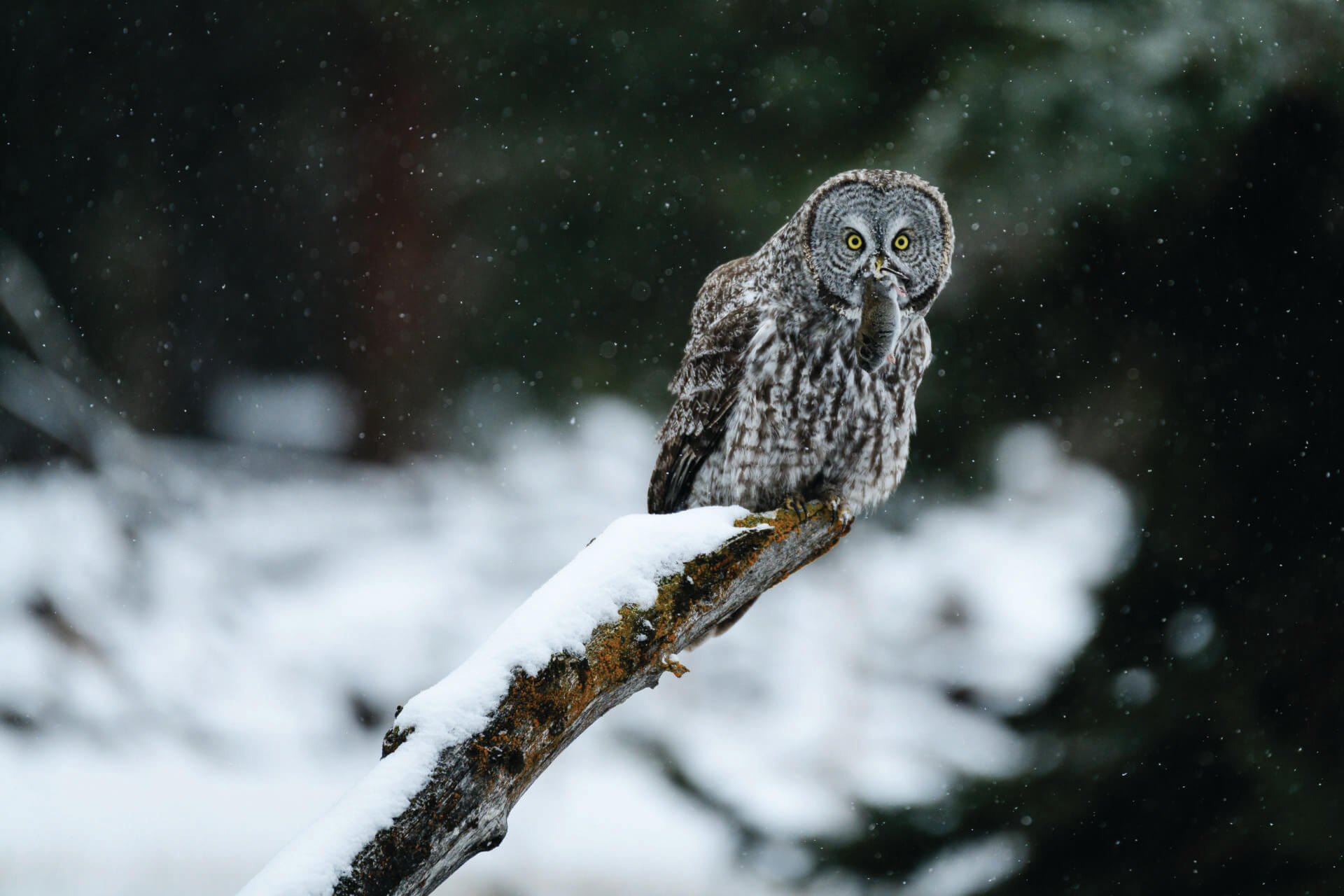
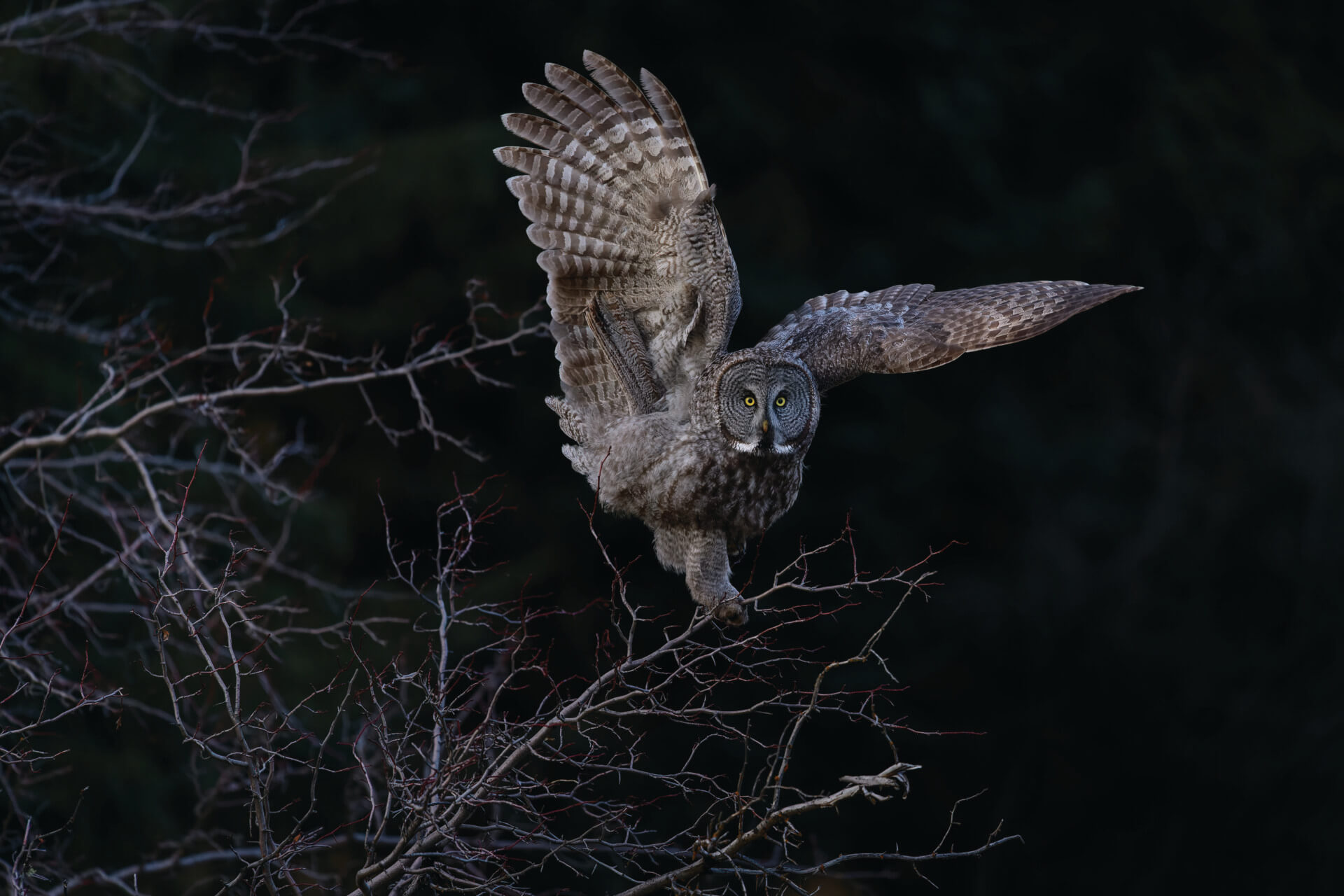
The special treatment for great grays crosses jurisdictional lines. In the Bridger-Teton National Forest—where many of Gura’s research bird territories are located—great gray owls are classified as a “sensitive species.” Their habitat needs are fairly specific, Gura says, emphasizing that messy, older forests that provide downfall cover for rodents and shade for chicks are most ideal. She talks as she climbs a snapped-off lodgepole pine tree—known as a snag—that a great gray had nested in back in 2023. “One of the biggest management recommendations for habitat managers is to retain these large dead snags,” she says. “When you’re coming through and cleaning up a forest, retaining these snags is really critical.”
The primary venue for the great gray study, Jackson Hole has a rich history of wildlife research projects that have spanned many years or even decades. Biologists who’ve lived here have discovered and mapped the longest-known pronghorn migration route in the world. They’ve teased apart how mountain lions and wolves influence each other and the landscape. The examples of long-term biological inquiries are many, but high on the list of well-known studies that have improved understandings of species are Olaus Murie’s examination of the Jackson Elk Herd, which began almost a century ago, and Frank and John Craighhead’s pioneering research on Yellowstone’s grizzly bears, which spanned from the late 1950s through the 1960s.
One of Gura’s professional goals is to keep tabs on the Greater Yellowstone’s gray owl population for decades to come—through the balance of her days as a working biologist. “I’m very committed to continuing our research in the GYE,” she says. “We’ve established such a strong foundation of information on this population, and these birds are facing so many changes.”
Bryan Bedrosian, conservation director at the Teton Raptor Center, knows Gura well—he led the great gray project for years and served as a mentor. He says she’s got what it takes to handle the sometimes-grueling work of a field biologist. “She’s got the perseverance of, really, no one else that I know and just that stick-to-it-iveness,” Bedrosian says. “We’ve got a saying around here that when you go out in the field with me or anybody else, you bring lunch. But when you go out with Katherine, you bring a lunch and a dinner.”
The continued presence of great gray owls in the Greater Yellowstone Ecosystem is uncertain. Based on predicted environmental change, by 2060 the species will no longer be found in the Lower 48.
Patla, the Game & Fish retiree, has witnessed the environmental changes affecting great gray owls firsthand. Decades ago, she says, great grays would congregate in impressive numbers in the cottonwood tree galleries outside of Tetonia, Idaho, but because of development or other reasons, they stopped showing up in big numbers. Meantime, the winter habitat conditions have changed. “I moved here in 1987, and the consistency and the duration of the snowpack have changed dramatically,” Patla says. “Without that consistent, powdery snow, the owls really can’t feed themselves during the winter.” By increasing the occurrence of wintertime rain, climate change figures to make the snow even less favorable—and not just for great grays. Rough-legged hawks, a wintertime visitor, are another snow-dependent raptor that could see their distribution change as the climate warms, Bedrosian says.
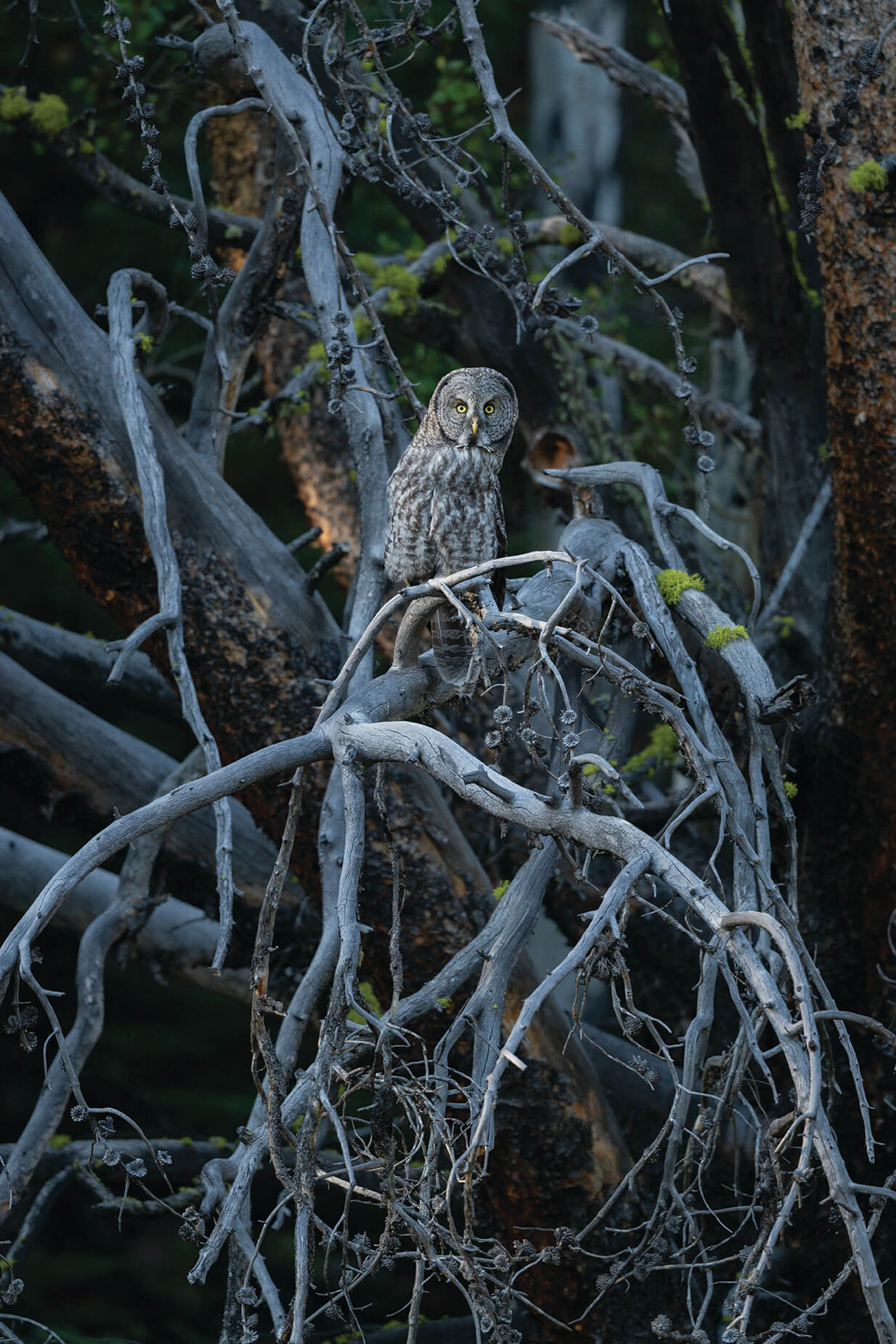
Although a long-running research project can put a spotlight on a species, Gura hasn’t sought publicity, even once turning down an acclaimed film crew that wanted to tag along with her for an extended period. Great grays don’t especially need the fanfare. In the worlds of ornithology and birdwatching, they’re already a rock star species. “The first one I ever saw was in Yosemite National Park in California, and I burst into tears,” Patla says. “It is one of the 10 most-wanted bird species for birdwatchers throughout North America. One feels a connection. They’re more active during the day. Their eyes, they look right at you. And they’re so large, but yet so quiet.” There’s enough sensation around Wyoming’s great gray owls, which are sensitive to disturbance, that their nest sites and even territories are closely guarded. “It’s censored on eBird [a bird-tracking app] for that reason,” says Wallace, the Game & Fish biologist. “The Raptor Center and parks keep all of their observations close.”
Nevertheless, some specimens earn celebrity status. Gura’s mind goes to a bird known as C3, a male great gray that the Teton Raptor Center captured and marked in 2014 who made himself famous by his choice of roadside territory in the south end of Grand Teton National Park. “It’s just incredible how many people got to experience a great gray owl through C3,” Gura says. After the famous bird’s transmitter died a couple of years later, he went missing, though in 2019 Gura managed to catch a glimpse of C3’s leg band while he was courting a female. The next day, she caught him again. “I was able to track him with a GPS transmitter the next several years, which was super cool,” she says. After nine years of being tracked as a research bird, the great gray owl known as C3 met his end. “We think it was by a mountain lion, based on tracks,” Gura says.
The Saturday last summer when Gura was out and about surveying for great grays along the southern reaches of the Wind River Range she was also in search of a celebrity, albeit one much more seldom seen. The bird that Stetler, the Wyoming Game & Fish biologist, had spotted two years prior was the southernmost known breeding great gray owl in North America. (Though the range of a genetically distinct Californian subspecies Strix nebulosa Yosemitensis does reach farther south.)
Over the course of hours, Gura hooted and combed over the Shoshone National Forest, scanning the skies for movement, timber stands for roost trees, and the wet meadows where great grays like to hunt for voles. Long after the journalist who accompanied her departed, she found the “exciting” evidence that she was looking for: Two fresh feathers, spotted in a grassy meadow just a couple hundred yards away from the old nest. “I’m sure they were around nearby!” Gura says.
Boreal Forest Denizens in the GYE
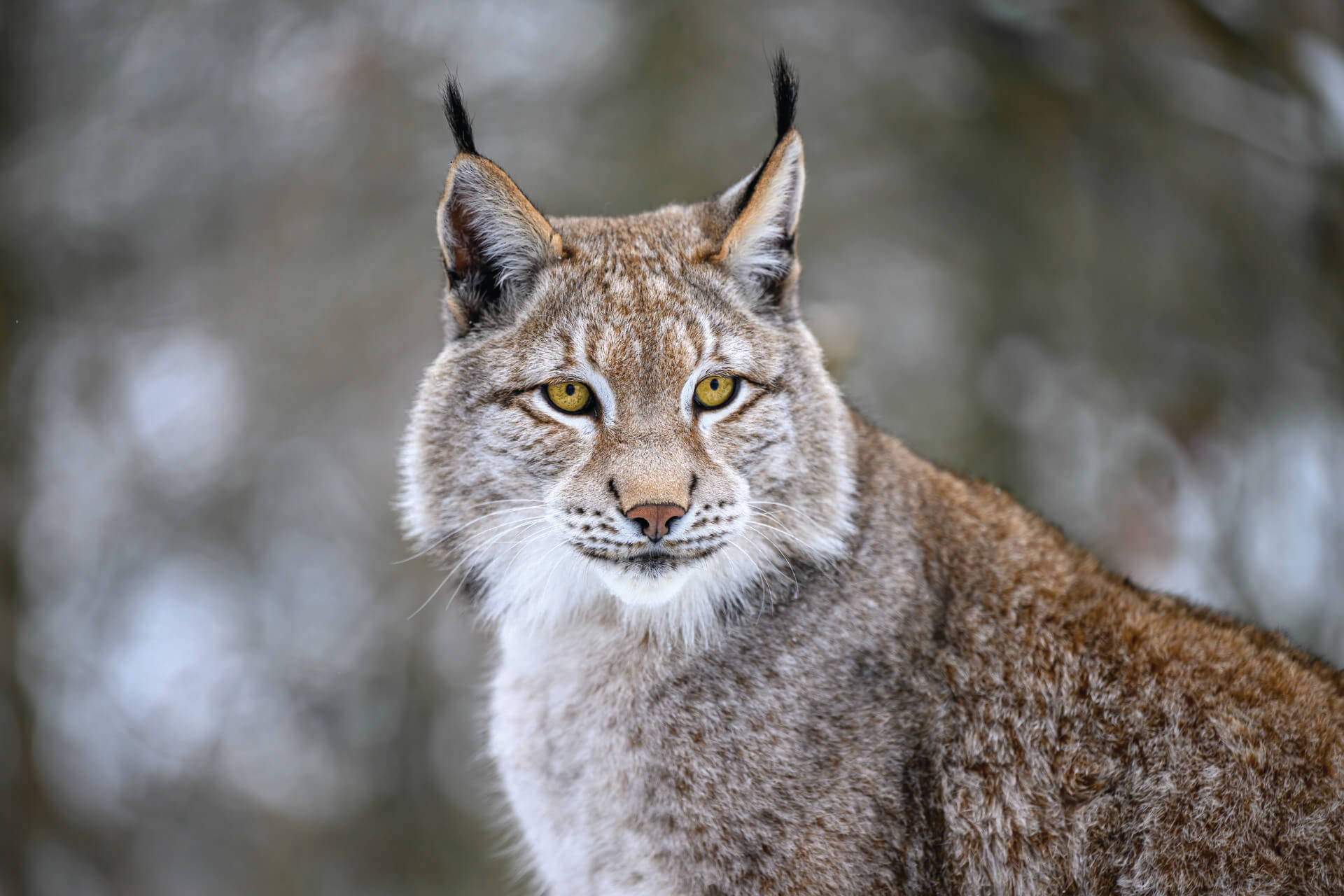
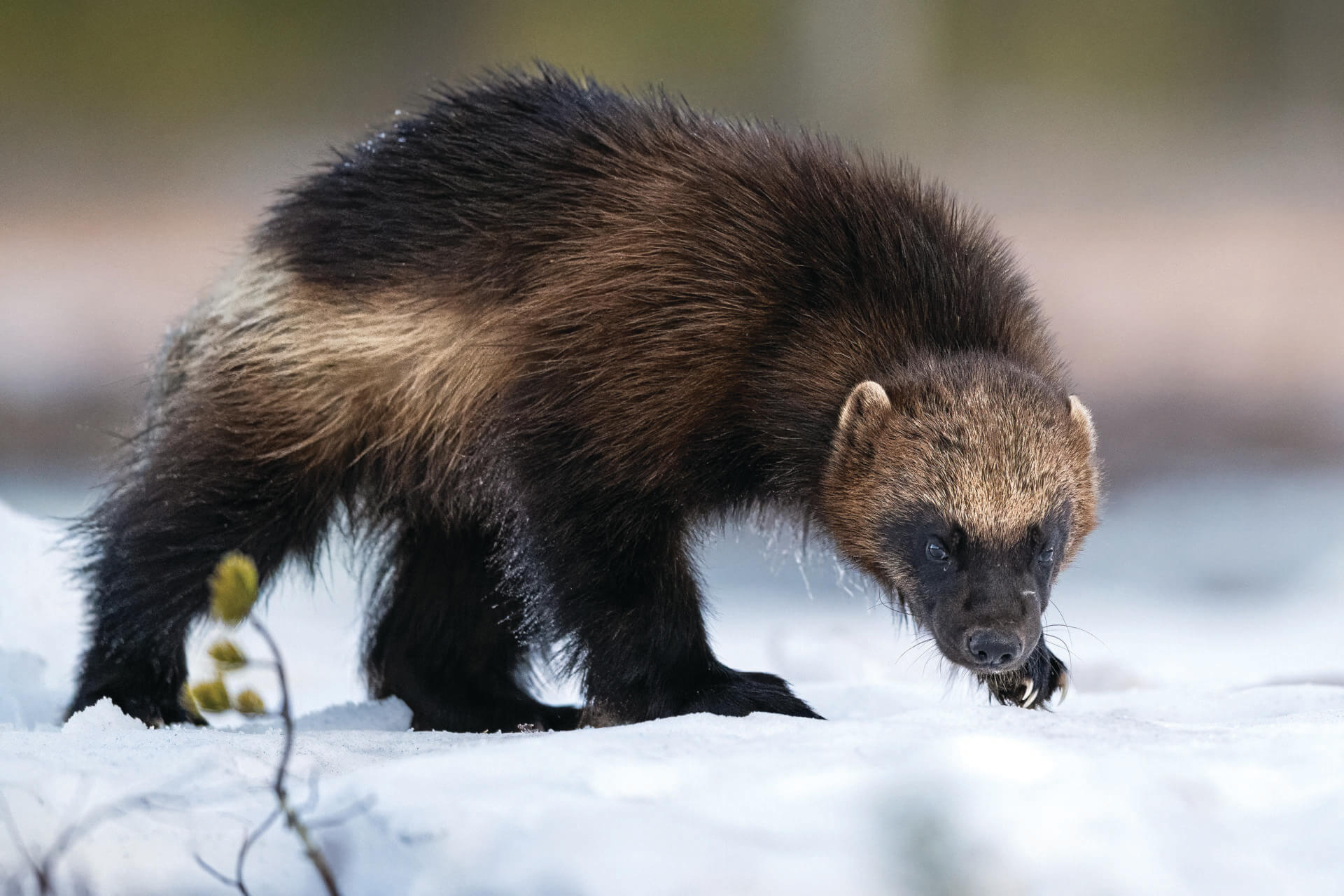
Because of its geographic location along the high-elevation spine of the Northern Rockies, the Greater Yellowstone Ecosystem is home to a number of species that are more typically found in the boreal forest that blankets much of Canada and Alaska. The conifers that exemplify the biome, also known as the taiga, also grow here—albeit in much smaller, mountainous swaths of the landscape. Here are snapshots of two other species that accompany gray owls as boreal forest denizens making a go at life in the Lower 48.
A charismatic, big-footed, pointy-eared wildcat, lynx are barely hanging on, if not completely absent from the GYE, federal and state surveys have concluded. Protected by the Endangered Species Act as “threatened,” the last known breeding lynx in the region were found in the Wyoming Range around the turn of the century. They may never thrive in the region again, being dependent on snowshoe hares that occur only in low densities in Wyoming. Still, there have been occasional sightings, most recently a mature tom that was treed by a mountain lion hunter’s hounds in the Gros Ventre Range in 2022.
Snow-dependent like great gray owls, wolverines are another species for which the GYE marks the southern-most end of its range. A midsized mustelid related to weasels and American marten, wolverines are known for being exceptionally aggressive and also low-density and hard to find. Nearly a decade ago, the Wyoming Game & Fish Department completed an exhaustive statewide survey that sought to map occupied wolverine range. The results: wolverines are found in many of the Greater Yellowstone Ecosystem’s mountain ranges, including the Wind River Range, Absaroka Mountains, Gros Ventre Mountains, and Wyoming Range. To the best of biologists’ knowledge, they’ve been extirpated from outlying mountain ranges, like the Bighorns and Snowies. Snow-dependent like great gray owls, wolverines are another species for which the GYE marks the southern-most end of its range. A midsized mustelid related to weasels and American marten, wolverines are known for being exceptionally aggressive and also low-density and hard to find. Nearly a decade ago, the Wyoming Game & Fish Department completed an exhaustive statewide survey that sought to map occupied wolverine range. The results: wolverines are found in many of the Greater Yellowstone Ecosystem’s mountain ranges, including the Wind River Range, Absaroka Mountains, Gros Ventre Mountains, and Wyoming Range. To the best of biologists’ knowledge, they’ve been extirpated from outlying mountain ranges, like the Bighorns and Snowies. JH