

Read The
Current Issue
Healing Art
You don’t have to be a patient to peruse the art collection at St. John’s Health.
//By Molly Absolon
//PHOTOGRAPHY BY ERIN BURK
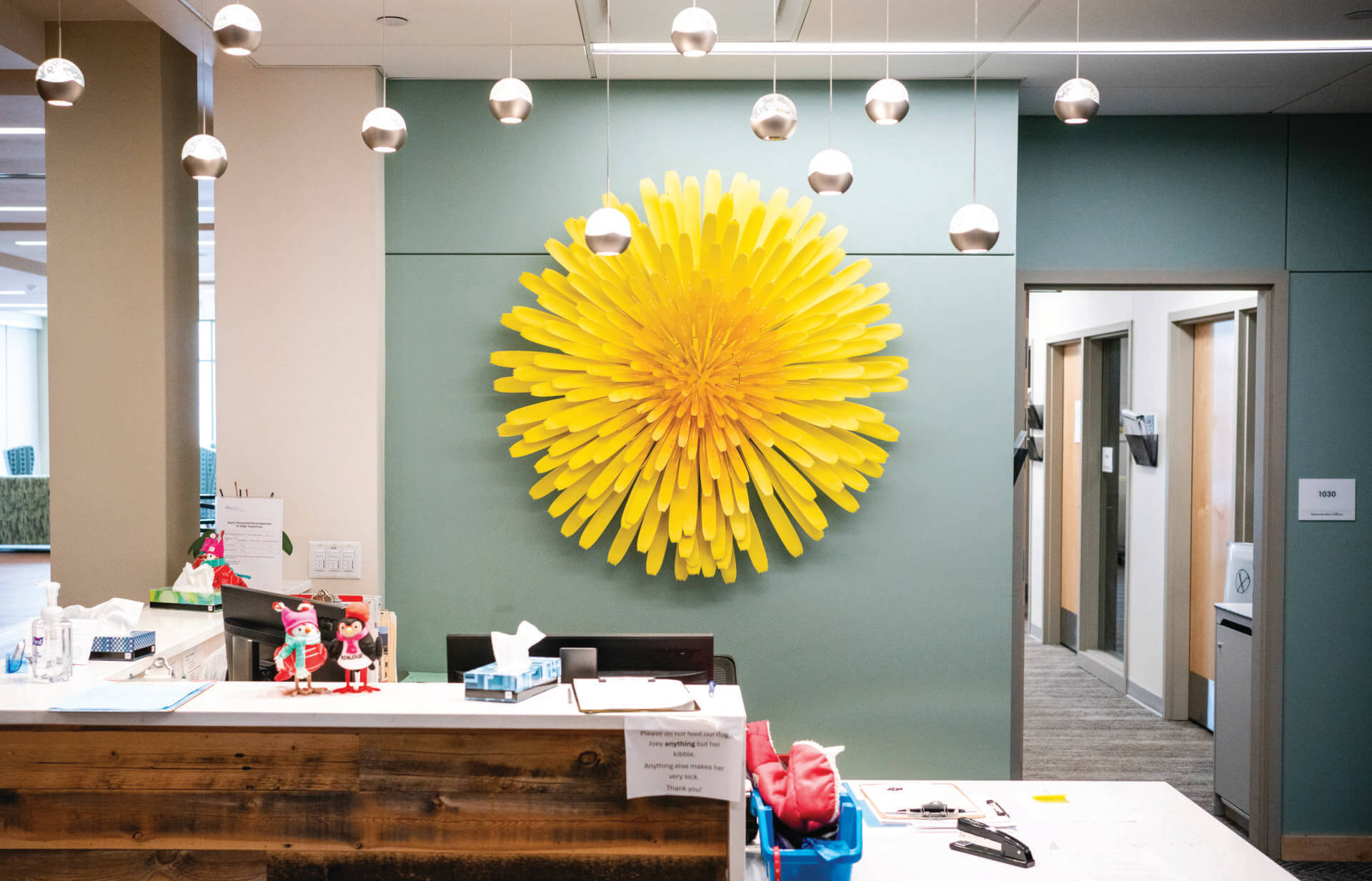
A giant yellow dandelion mounted above the front desk at St. John’s Health’s Sage Living Center greets visitors as they enter the facility. Made from cut steel by Jackson artist Ben Roth, the dandelion brings to mind sunshine and summer. It’s a happy, positive piece, and the feeling it conveys is intentional. The dandelion was selected in 2019 by a committee of hospital staff, community members, and art professionals to help decorate the then-under-construction assisted-living center, which welcomed its first residents in 2021. But the artworks are not just decorative.
All the pieces on display at the Sage Living, as well as throughout the neighboring main hospital and medical office building, are carefully curated to promote wellness and healing. “We used evidence-based criteria to build St. John’s art collection,” says Carrie Geraci, the executive director of Jackson Hole Public Art, a nonprofit that has been working with St. John’s since 2016 to help tailor its collection to maximize art’s healing power.
“Studies have shown that soothing artwork—landscapes, verdant vegetation, wildlife, flowers, familiar scenes—help you enter a calm and relaxed state, versus looking at a painting that is of, say, a Western gun battle, which is iconography we may see in this community but that is not appropriate for a health center,” Geraci says. What is appropriate, according to Geraci, is art that helps support emotional, spiritual, and physical wellbeing.
Humans have expressed themselves artistically for as long as we’ve existed. Cave paintings and rock art dating back tens of thousands of years give evidence to art’s longstanding importance in our lives, but that impact has been hard to measure in the past. Now studies from around the world, including research by the Cleveland Clinic, the World Health Organization, and Johns Hopkins University, provide data to back up what we’ve always known instinctively.
Art can help reduce loneliness, stress, and depression. Patients who have views of nature, rather than a blank wall, have been found to require less-potent painkillers and end up with shorter hospital stays. Art therapy has been shown to alleviate anxiety in cancer patients and help restore the human spirit.
With these findings in mind, St. John’s Health launched its Art and Healing Program in 2016 in collaboration with the St. John’s Health Foundation and Jackson Hole Public Art. Part of the program involved looking closely at the works exhibited on the hospital walls in an effort to foster a more welcoming, soothing environment for patients, staff, and visitors to the hospital.
“For many years, St. John’s accepted artwork as a form of donation, but not all art meets the art and healing criteria,” says Marcus Stouffer, St. John’s Health’s patient experience director. “If we receive art as a donation that isn’t appropriate, it may go to auction, so it still is a positive for the hospital.”
The hospital’s selection committee’s criteria include paintings and sculpture of healthy wildlife, calm landscapes, flowers, and familiar scenes. They look for works that capture the ethereal movements of wind, water, and air, or scenes that trigger positive memories and connections. Through the financial support and leadership of the hospital foundation, today the hospital campus has an impressive permanent art collection that highlights local and regional artists, as well as several pieces on temporary loan.
You don’t have to be a patient to enjoy the collection. Visitors are welcome. The artwork is well signed and often includes an artist statement to help viewers learn more about the work’s history and the artist’s intentions. Sage Living has an illustrated pamphlet available at the reception desk that enables people to do a self-guided art walk through the facility. Most of the center’s residential neighborhoods are open throughout the day. Permission, which can be obtained at the reception desk, is required to enter Wildflower Way, Sage Living’s memory care unit.
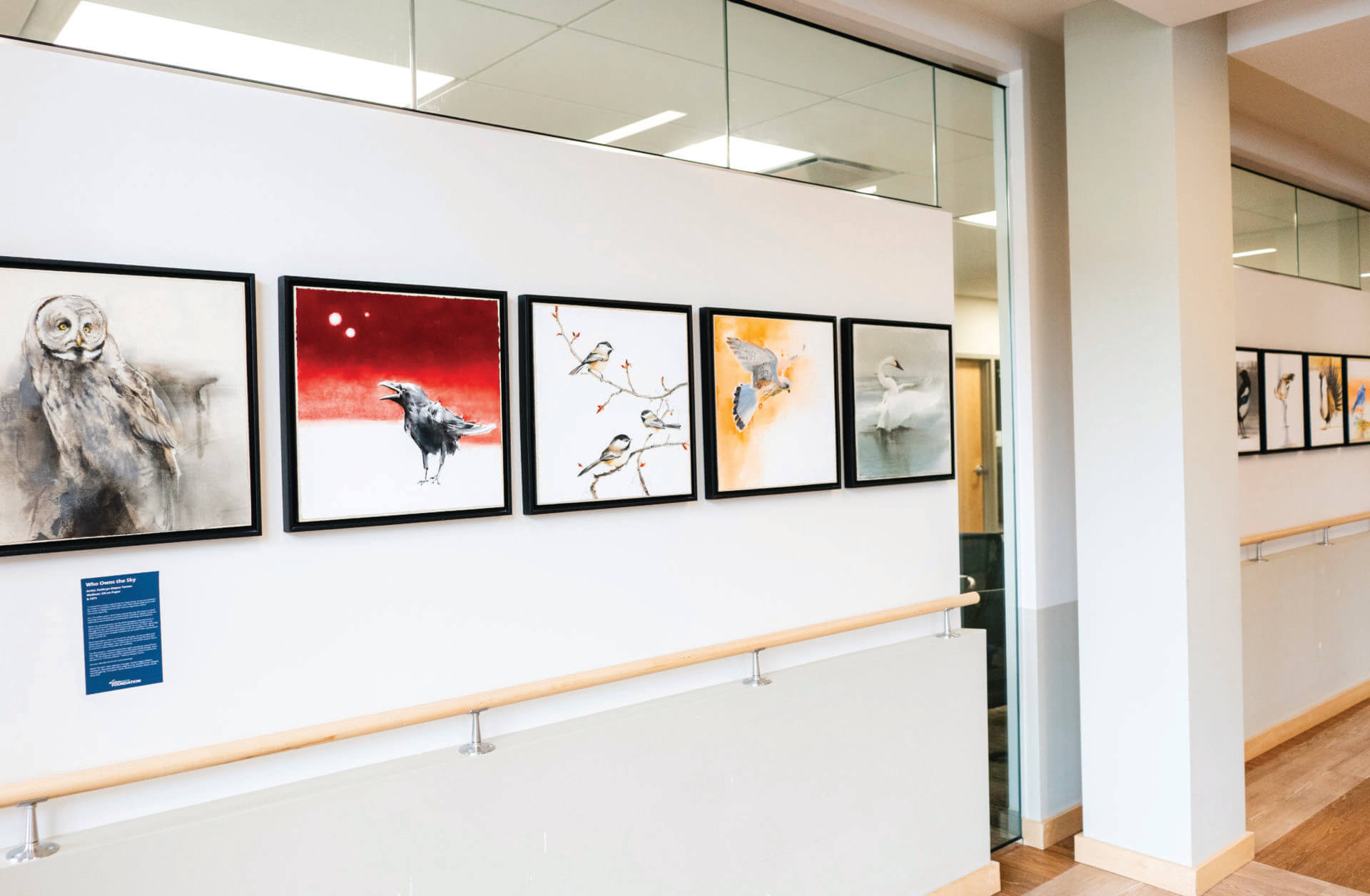
Along Sage Living’s main corridor is Who Owns the Sky, a series of 15 paintings of birds (and one nest) by Jackson-based artist Katheryn Mapes Turner. Turner, whose family manages the Triangle X Ranch in Grand Teton National Park (read more about the Triangle X, which celebrates its 100th anniversary this year, on page 54), painted birds that would be familiar to residents—a raven, a Western tanager, a sandhill crane, and a magpie, among others. “I created [Who Owns the Sky] specifically for Sage Living,” Turner writes in her artist statement. “It was my intention to create an installation filled with color, that would uplift spirits with the sense of delight and wonder that we experience when encountering birds.”
In Sage Living’s Great Room, a line of silvery metal feathers created by Bland Hoke rises like smoke for roughly 20 feet above the chimney. As they float up toward the sky, the feathers leave viewers with a sense of freedom and lightness.
Elsewhere are two paintings by Kelly-based artist Wendall Field, Yurtian Kitchen and The Show Is About to Begin (shown at left). The former depicts open shelves in a kitchen, complete with ordinary objects like a clock, a roll of paper towels, and a wine bottle. The objects are painted in a primitive style with bright colors that trigger the sensation of a cozy, warm home. It’s an image that might be comforting for residents displaced from their own homes due to illness or infirmity.
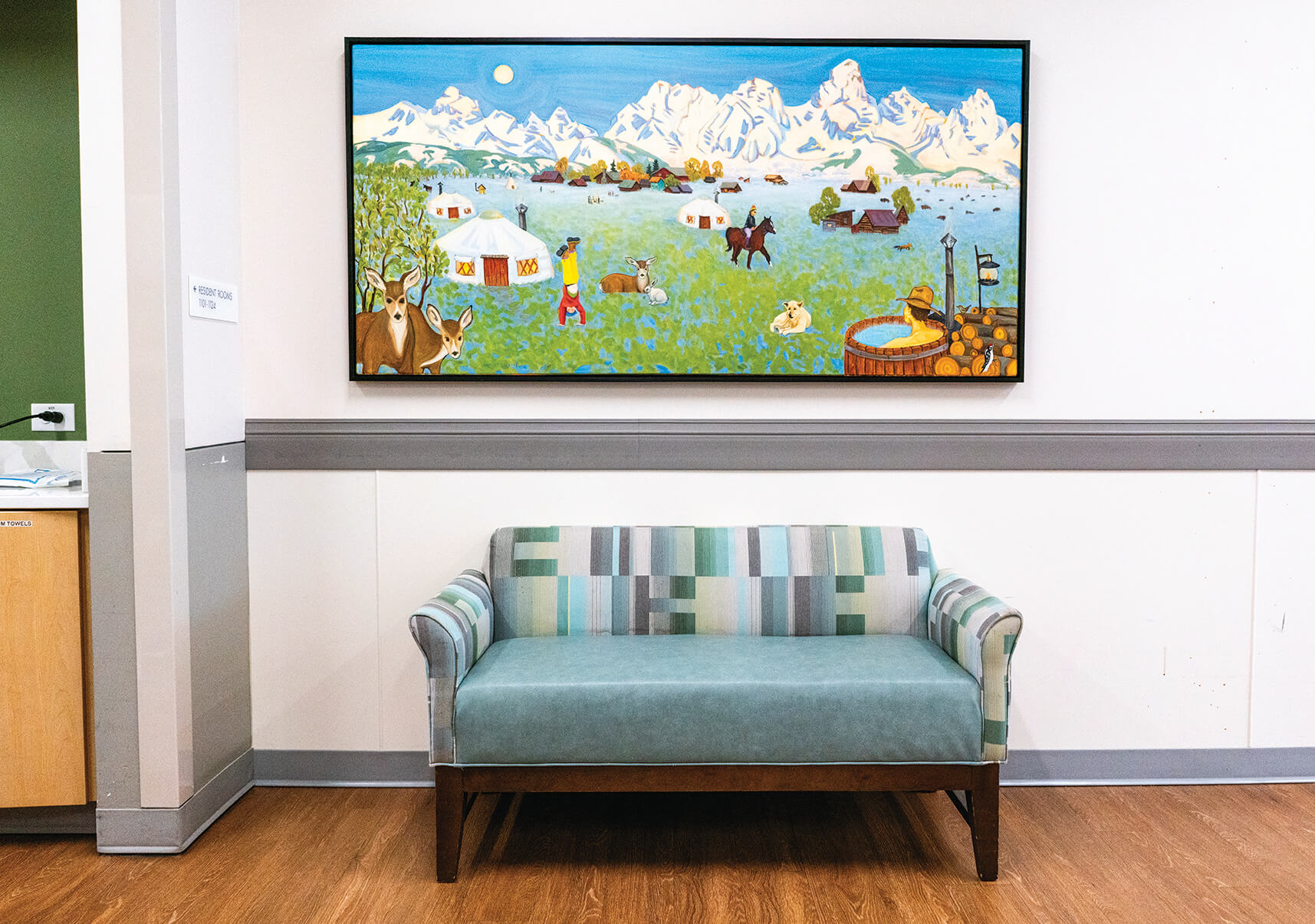
The Show Is About to Begin is of a scene in the Kelly yurt park, where 13 yurts rise beneath the shadow of the Tetons. Conjuring a typical summer day, the work invites a story. There’s someone riding a horse, while another sits in a hot tub. A dog basks in the sun, and a deer sits peacefully next to a rabbit. You can see cabins, grazing bison, yurts, and a tipi; look closely to find details like an outhouse, fox, and a tiny moose. Nurse Mark Bergstrom says he has seen one nonverbal patient—it hangs in the memory-care unit—stare at it for long periods of time. What she is looking for or thinking, Bergstrom doesn’t know, but he believes the painting brings her joy.
“I created [Who Owns the Sky] specifically for Sage Living. It was my intention to create an installation filled with color, that would uplift spirits with the sense of delight and wonder that we experience when encountering birds.”
kathryn turner
Anecdotally, such emotional impacts are obvious and can be felt by anyone who comes into contact with St. John’s art program. The halls that exhibit thoughtful, brightly colored art feel welcoming and show a commitment to quality care. In contrast, the few hallways with blank beige walls feel sterile, cold, and disorienting.
“We recognize the void—the absence of art—almost more than we realize its power,” says Jackson painter Katy Ann Fox, who has 15 small-format paintings of houses and buildings permanently hanging in Sage Living and a handful of additional pieces on temporary exhibit in the main hospital building. “Without art, we feel panic and angst. Art takes the edge off,” she says.
Fox grew up hanging out with her grandmother at a nursing home, and she thought of that relationship when she submitted her proposal to the selection committee for Sage Living. She wanted images that invited stories and evoked memories, and the array of paintings she created does just that. JH Public Art’s Geraci says she’s seen caregivers use Fox’s paintings of houses to stimulate conversations with Sage Living residents about their lives and the homes they lived in before moving into the facility.
Amber Mouton, Sage Living’s life-enrichment manager, says, “I can imagine myself as a resident, walking down the hall of one of our neighborhoods, and seeing Wyoming wildlife photography and snowy Wyoming scenes. That must feel comforting. A gentle reminder of where you are and what you know.” JH