

Read The
Current Issue
A Historic Jackson Hole Barn
// By Katherine Wonson
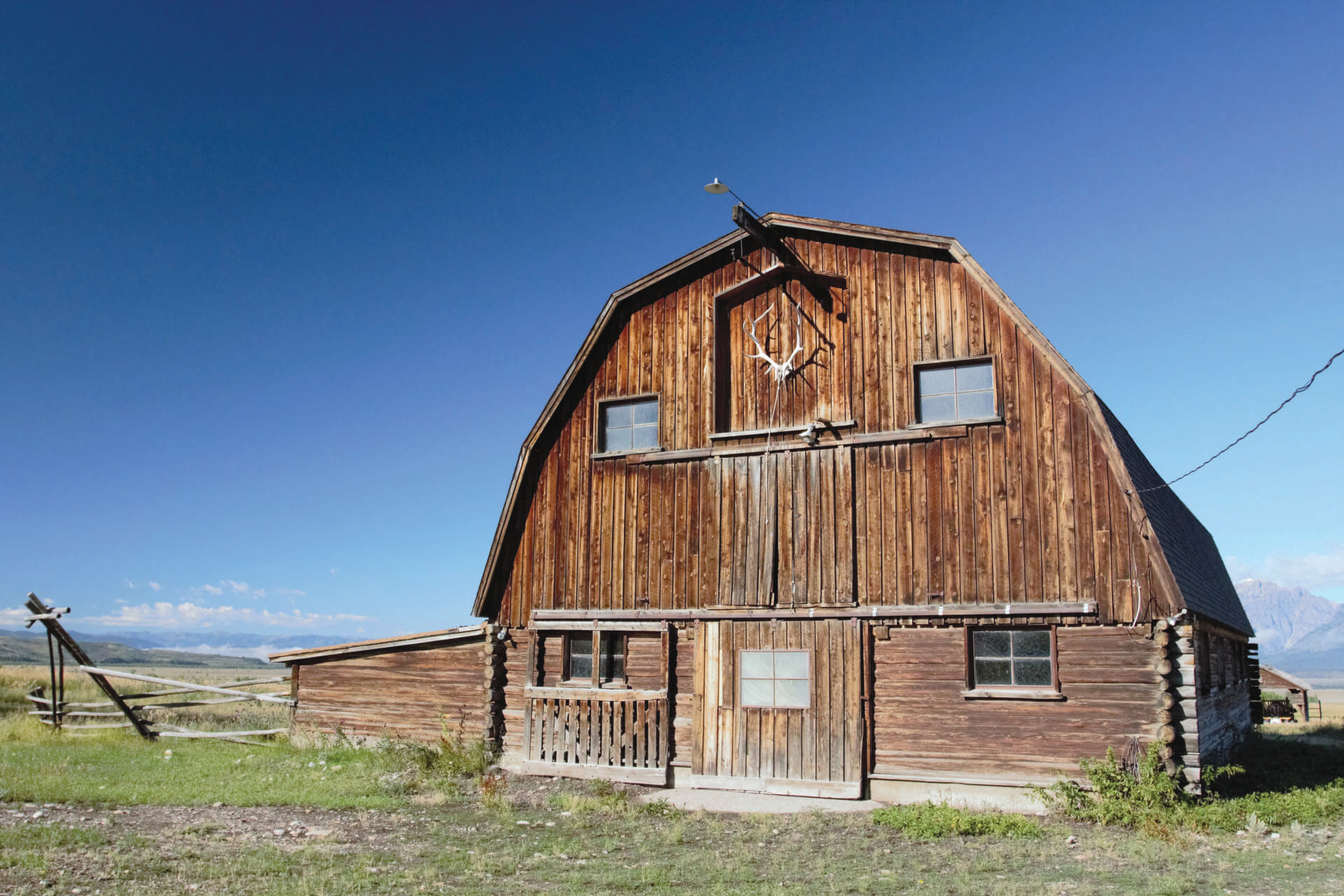
Every historic barn tells a story. The architectural details, materials, and placement of the barn can speak volumes about who built it, who lived there, and how Jackson Hole has changed since its construction. Every barn has a similar “anatomy” or set of components that help it function as an agricultural structure to house livestock and store feed, tack, and equipment.
The Hunter Hereford Barn, located east of Mormon Row in Grand Teton National Park, was built around 1947 by architect Eber Piers of Salt Lake City for Bill and Eileen Hunter, who owned one of Jackson’s early Ford dealerships. The couple had relocated to Jackson from Ogden, Utah, with the intention of building a hobby ranch. The August 23, 1951 issue of Jackson’s Hole Courier quoted the couple as saying they would spend the rest of their lives enjoying a well-earned vacation and raising Hereford cattle as a hobby on their ranch. Unfortunately, Bill died of a heart attack just one year into his ranching-retirement dream.
While the Hunters’ hobby ranch didn’t last long, its barn still stands today. Piers’s design was largely based on a barn in nearby Wilson (the Hardeman Barn, which still stands today on the campus of the nonprofit Teton Raptor Center) and was intended to blend rustic style seen on nearby Mormon Row with modern amenities such as electricity and plumbing. It featured a large dance-ready hayloft and log construction inspired by homesteading barns, and served as a movie set for the 1970 Western The Wild Country. It exemplifies the valley’s hobby-ranch-era barns and is one of only a handful of historic barns remaining in Grand Teton National Park.
Winter Door and Summer Door
Just like people need different coats for the winter and summer, a barn needs two different door systems. Summer doors provide ventilation through their slatted, open-top construction. By contrast, in the freezing-cold months, winter doors provide greater insulation while still allowing light. This is done with the addition of a single window centered on the door. The Hunter Hereford Barn is one of the few historic barns in the valley that still retains both its summer and winter doors. Typically, once a historic barn is no longer being used for agriculture, ranch owners simply repair or replace just one of the doors and remove the other.
Gambrel Roof
The roof shape can indicate a lot about a barn’s history. The gambrel roof shape, with its unique double-sloped design, was commonly used in barn architecture because it created a large volume of space in the second story, allowing for greater hay storage without increasing the barn’s footprint. Though highly practical, the gambrel roof required experienced craftsmen and careful planning, luxuries most early-20th-century homesteaders did not have. The use of a gambrel roof or windbreak Gothic roof signifies later and more sophisticated construction, often belonging to more established or wealthy ranchers.
Hay Loft Door and Hay Trolley
These tall doors allow for second-story storage of animal feed and ventilation and served as the entry point for loose hay into the barn. Ranchers lifted loose piles of hay with a hay fork hung from the hay trolley. These doors also allow for easy access to remove hay, though barns like this one have interior hay chutes that allow the rancher to simply push hay from the second story to the feeding troughs on the first (much like how we think of a laundry chute today).
Interior Stairs
Unseen on the inside of the barn, stairs may seem like a given in a two-story barn, but in Teton County, that is far from the reality. During the homesteading era, barns used horizontal, nailed dimensional lumber attached to the walls as a makeshift ladder to reach the second story. By the 1920s, staircases were found in some valley barns, but the reason wasn’t what you would expect. Mel Annis, a local builder at the time, volunteered to provide the labor to upgrade a barn’s standard ladder to a staircase if the owner supplied the materials. This was to allow his wife, who needed stairs to reach the second story, to attend the traditional barn dance that took place after a barn was finished.
Notch Corners
The way two walls are joined can be a telling detail. The saddle notch (or cope) corner is the most sophisticated of the log-notch types and signifies the involvement of experienced craftsmen such as the Nelson Brothers, who built this barn. It requires the use of log-building-specific tools and is a far cry from the simple V-notch found in the valley’s earliest buildings, which could be made with the precise use of an ax. JH