
Read The
Current Issue
Known | Underappreciated
It’s likely these four Jackson Hole icons are already on your to-do list; make sure to check out each one’s lesser-known counterpart.
// By Dina Mishev
Known | Old Faithful
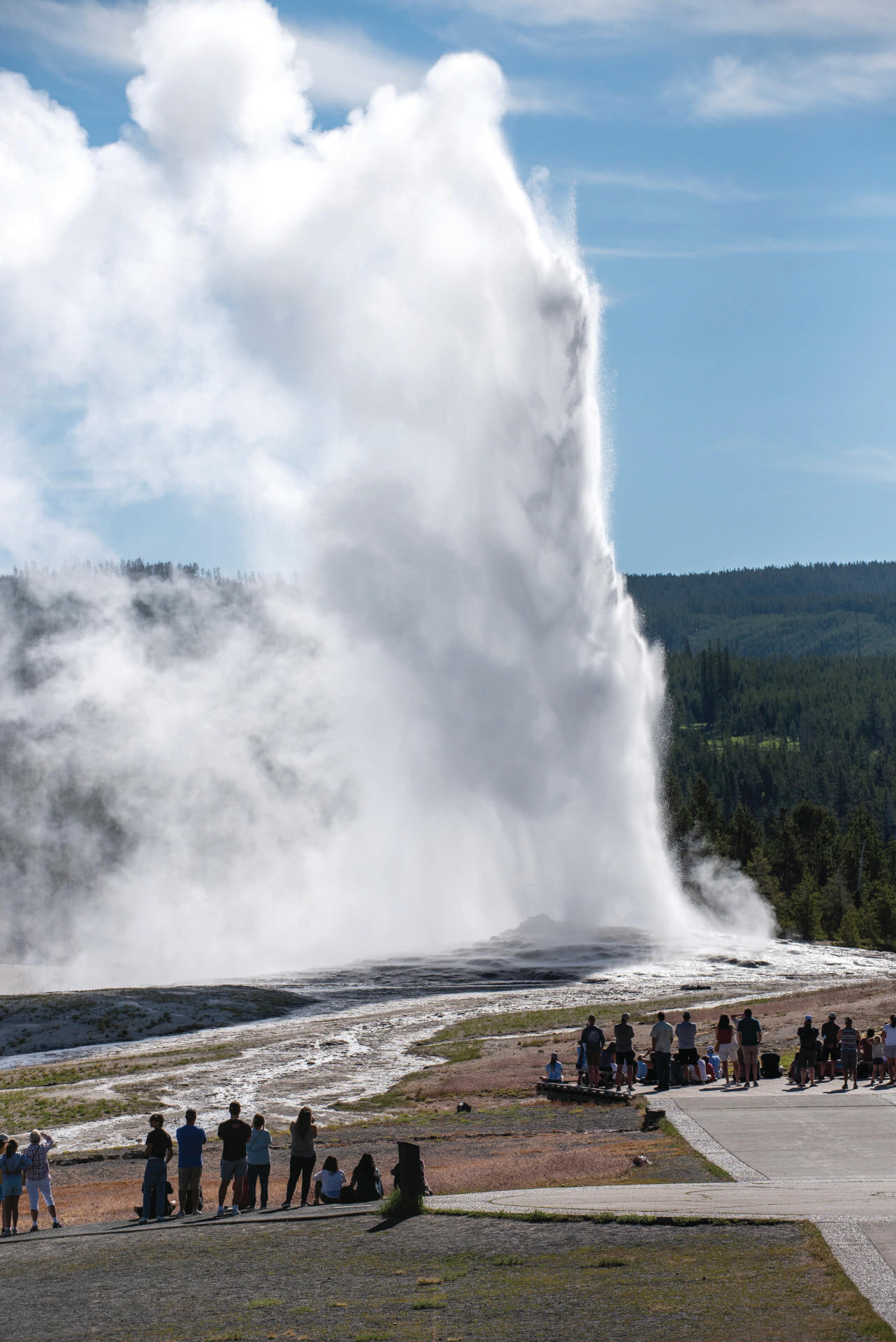
Named by the Washburn Expedition of 1870, Old Faithful is Yellowstone National Park’s most famous geyser and one of the world’s best known. Spouting boiling water between about 90 and 185 feet high roughly every 91 minutes, it is neither the park’s largest geyser nor its most regular, but it is the largest geyser that erupts with some predictability. Yellowstone is home to more than 1,200 geysers (about 420 of which are active in any given year) and around 10,000 thermal features, and Old Faithful is the single most visited. During peak summer months, an estimated 2,000 people gather for each eruption, packed onto two-tiered bleachers, standing behind them, or sitting on the boardwalk at the front.
Despite the crowds, it is still worth seeing. To avoid some of the crush and get a different vantage point, watch an eruption from the end of the Old Faithful Observation Trail, or from the second-floor rooftop deck of the historic Old Faithful Inn. Book room 150 in the Inn’s Old House, and you can even watch eruptions from your window. Whenever you go, download the National Park Service’s Yellowstone–Geysers app, which includes geyser webcams and daily eruption predictions.
Old Faithful is about 95 miles from downtown Jackson, on the western side of Yellowstone Park’s lower loop road.
Underappreciated | Steamboat Geyser and Norris Geyser Basin
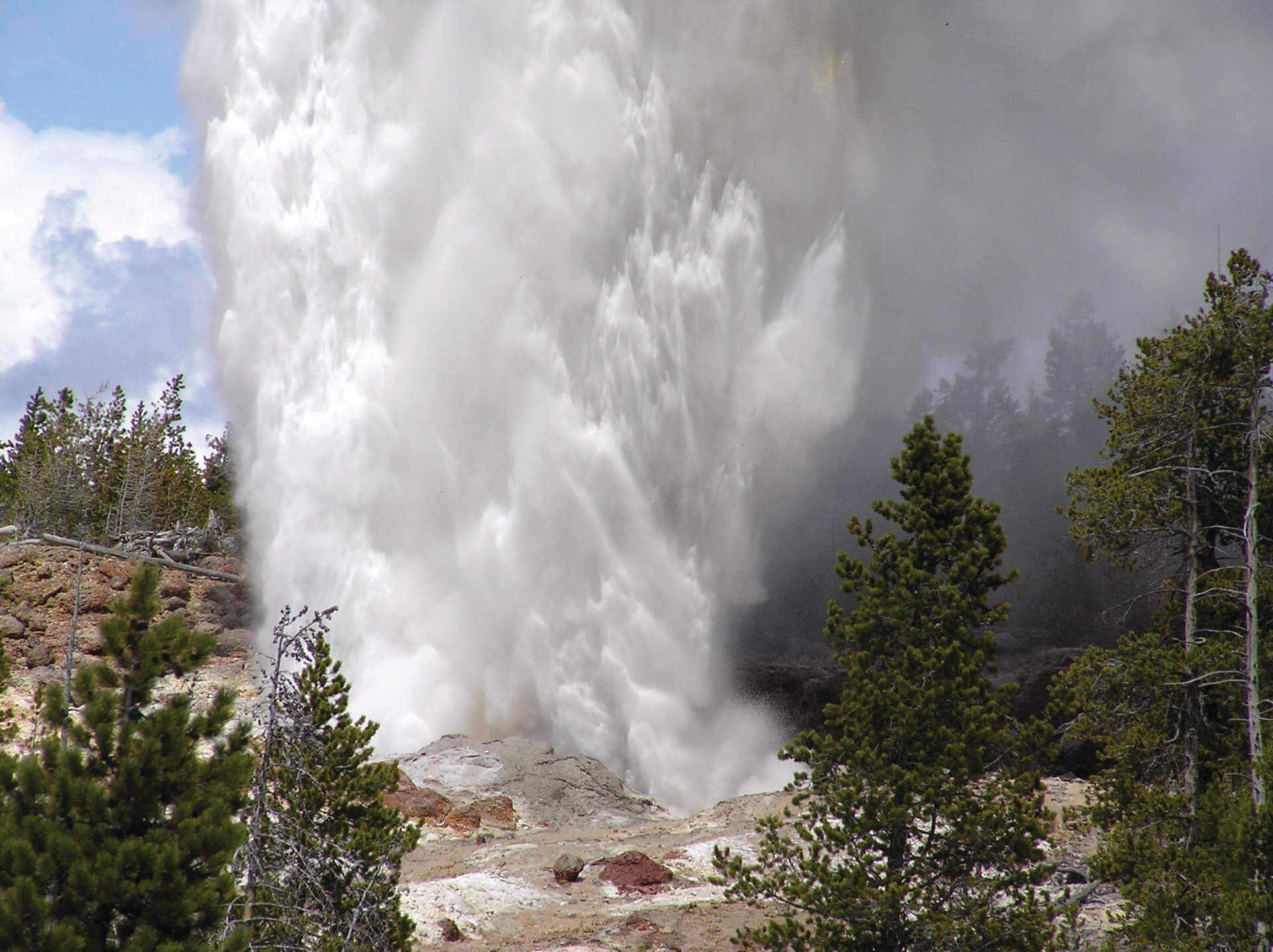
For a few years in the early 1900s, New Zealand’s Waimangu Geyser hurled water as high as 1,600 feet, but it went dormant after a 1904 landslide altered the local water table. Since then, Yellowstone’s Steamboat Geyser, in Norris Geyser Basin, has held the title of tallest active geyser in the world. Its eruptions are wildly irregular—intervals have ranged from four days to nearly 50 years—but since 2018, it has been relatively active. In 2018 it erupted more than 30 times; in both 2019 and 2020, it erupted almost 50 times. After erupting only three times in 2025, it went off twice in early 2026. When Steamboat does erupt, the display is spectacular: water can shoot up to about 345 feet in the air for anywhere from 3 to 40 minutes.
Catching an eruption is largely a matter of luck, but Norris Geyser Basin is still a worthy stop. Norris is the hottest, most acidic, most changeable, and most varied thermal area in Yellowstone. Several miles of trails radiate from the Norris Geyser Museum, which opened in 1930 as one of Yellowstone’s original museums. Designed by architect Herbert Maier in the rustic stone-and-log style now known as “parkitecture,” the museum has been on the National Register of Historic Places since 1983. The signed trails pass fumaroles, geysers, hot springs, colorful pools, boiling mud, and Echinus Geyser, the largest known acid-water geyser in the world. (Acid-water geysers are extremely rare, and Norris hosts most of the ones known to exist.) Green Dragon Spring, a sulfur-lined cave filled with emerald-green boiling water, is frequently cloaked in steam, making the opening look like it’s exhaling smoke. As a final bonus, Norris is surrounded by lush riparian meadows that often attract wildlife, adding another reason to linger.
Norris Geyser Basin is about 30 miles north of Old Faithful.
Known | Moulton Barn
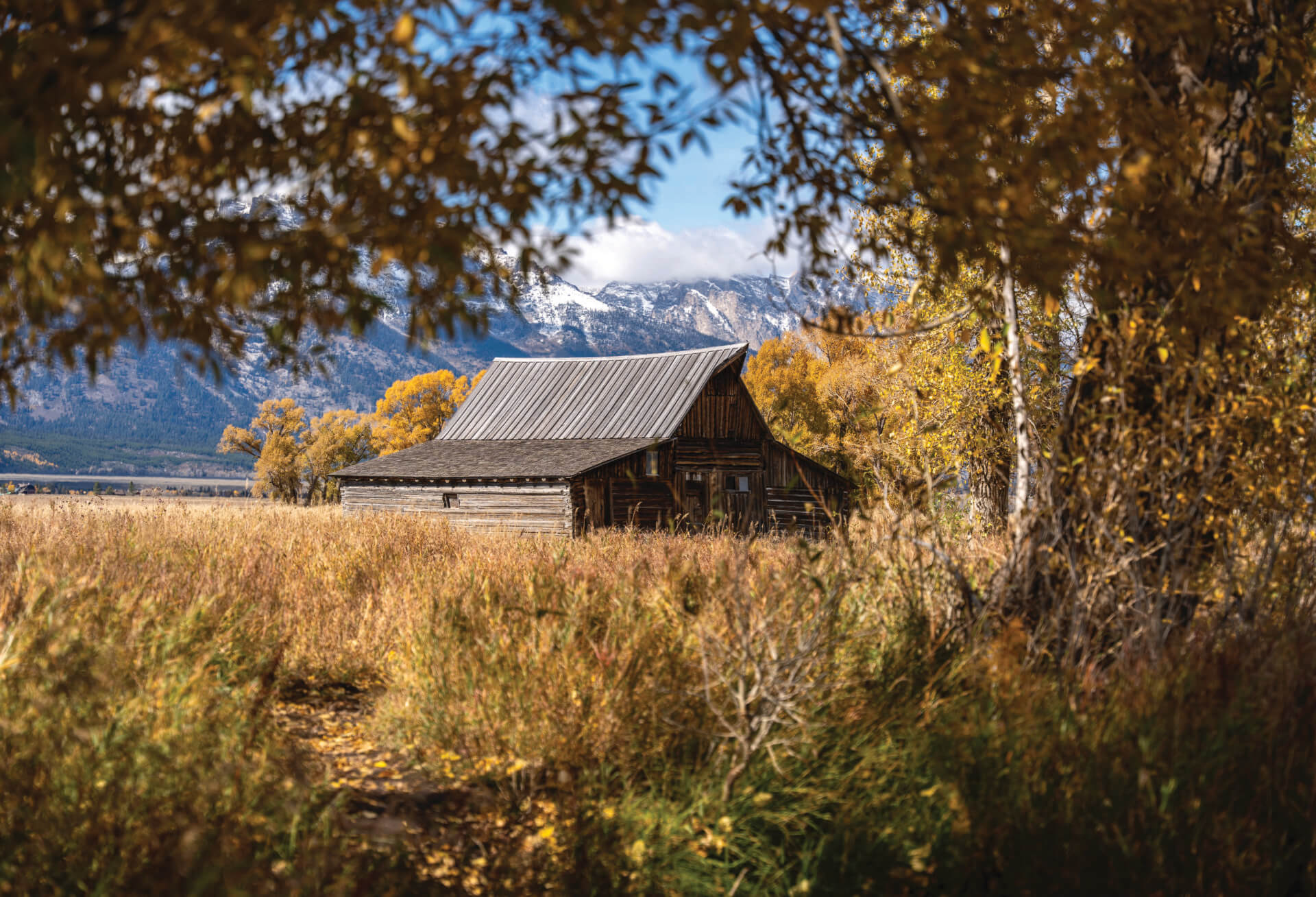
Built in stages between 1913 and 1938, the T.A. Moulton Barn in the Mormon Row Historic District of Grand Teton National Park might be the most photographed barn in the world. With the Tetons rising sharply behind, it makes a gorgeous image. Thanks to a multiyear, $5-million public-private partnership focused on preservation, rehabilitation, and new interpretive elements, the area is on its way to being more than just a backdrop for pretty pictures. The collaboration between Grand Teton National Park and the Grand Teton National Park Foundation is slated for completion in 2027 and will eventually share the history of the area and the lives of early white settlers through signage, audio and video tours, and experiences on the National Park Service mobile app. Additional parking will help accommodate the hundreds of visitors who arrive daily (expect to see construction of these improved parking and arrival areas and accessible pathways this summer).
“Preserving Mormon Row while improving how people experience it is one of the most important investments we can make in protecting both the historic structures and the stories they represent,” says Grand Teton National Park Foundation president Leslie Mattson.
Mormon Row is on Antelope Flats Road, off U.S. Highway 191/26/89, roughly a mile north of Moose Junction.
Underappreciated | Cunningham Cabin
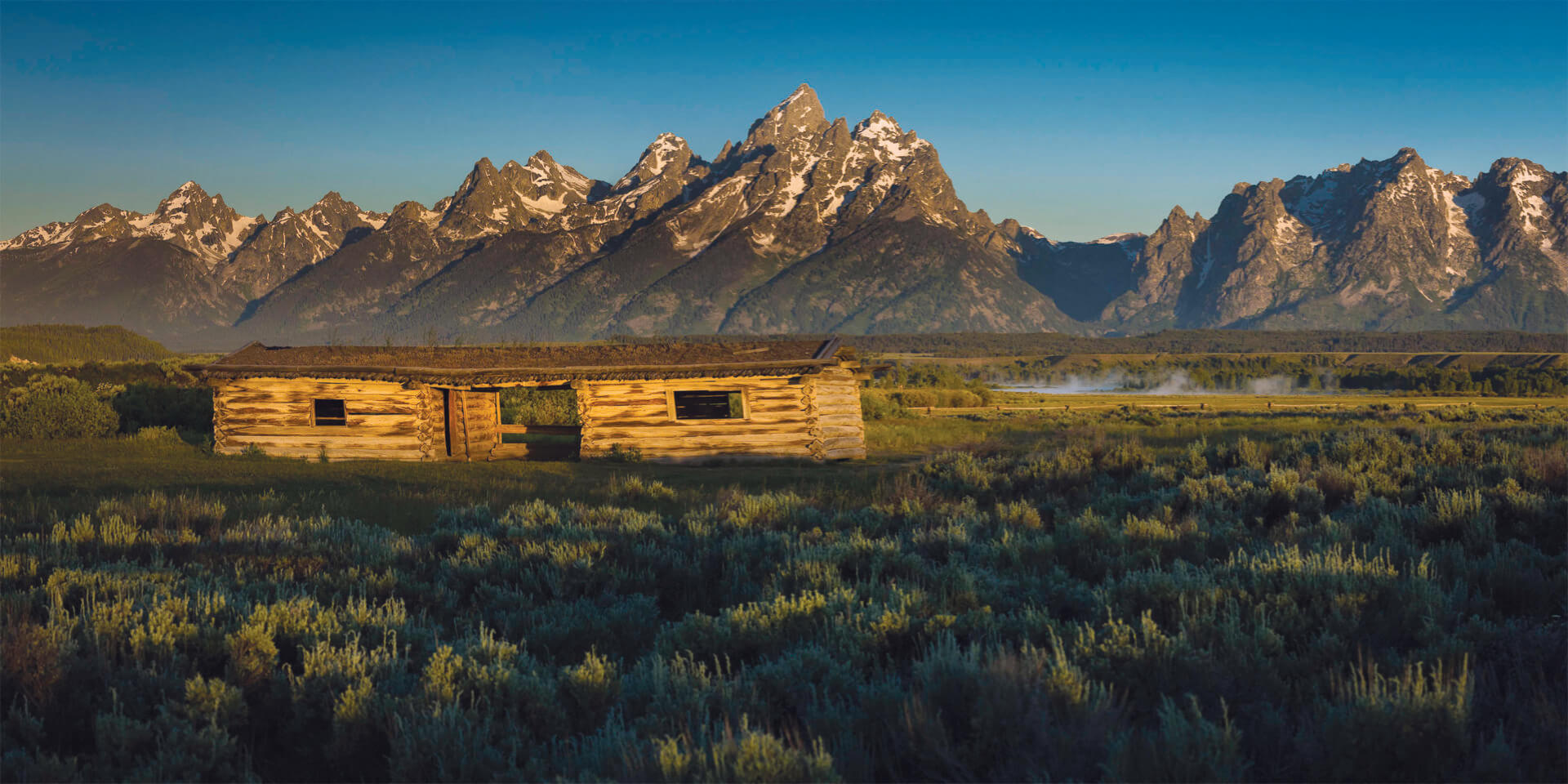
John and Margaret Cunningham homesteaded here and founded the Bar Flying U Ranch in the 1880s. Their cabin, built in 1888 using local logs and no nails or metal, is one of the oldest still-standing homestead cabins in the valley. It’s an example of an Appalachian-style “double-pen” or “dog-trot” cabin—two rooms connected by a breezeway. The Cunninghams lived in the southern cabin and used the other as a blacksmith shop until 1895, when they finished their main house. After that, the structure became a barn and smithy. Invisible from the road, the cabin, like the Moulton Barn, offers the chance to photograph an old building with the Tetons as a backdrop. Here, you can frame the range through the cabin’s windows or behind a buckrail fence. The cabin was added to the National Register of Historic Places in 1973.
It also has a more dramatic history. In the fall of 1892, two men from Montana approached Cunningham to buy hay. He allowed them to winter at the Bar Flying U. Rumors soon spread that these supposed wranglers were actually horse thieves. The following spring, four men—claiming to be a U.S. marshal and deputies—arrived from Idaho and shot the alleged thieves. The men’s guilt, the allegations, and the lawmen’s identities were never confirmed.
The Cunningham Cabin is off U.S. Highway 191/26/89, 12.8 miles north of Moose Junction and 6 miles south of Moran Junction. A short interpretive trail leads from the parking lot to the cabin.
Known | Inspiration Point and Jenny Lake
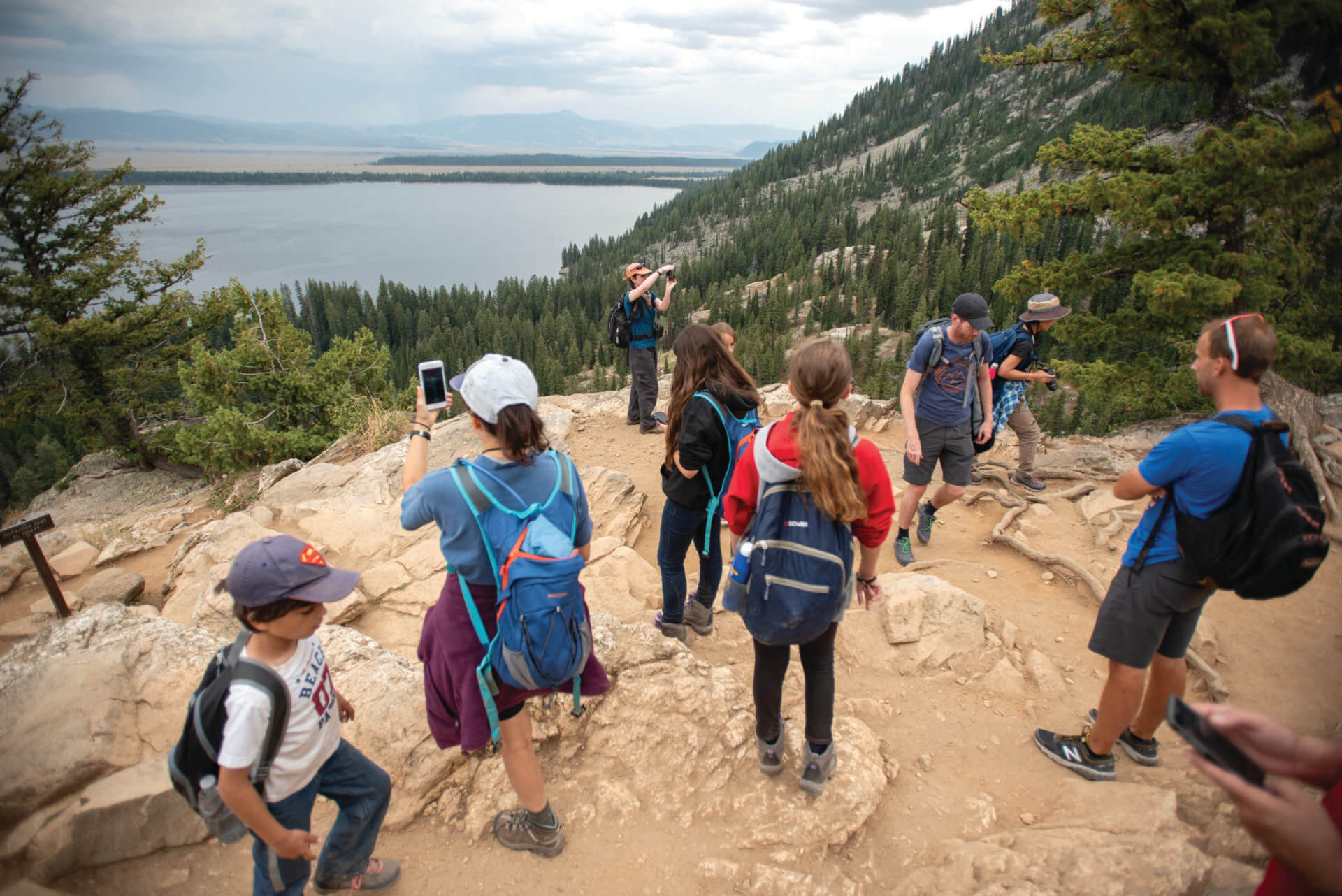
Jenny Lake is one of Grand Teton National Park’s most visited sites. This glacial basin at the foot of the Teton Range was formed by retreating ice about 12,000 years ago and named for a Shoshone woman who lived in the valley in the late 1800s with her husband, trapper and guide Richard “Beaver Dick” Leigh. Both assisted early explorers mapping the range. Jenny and several of her children died during a smallpox outbreak in 1876. Today, the 423-acre lake is popular for its still-water reflections of the range’s major peaks and its web of hiking trails.
Jenny Lake’s eastern shore has a developed campground, a small ranger station, a convenience store, bathrooms, and short interpretive trails. Its western shore is wilder and only accessible via a privately run shuttle boat across the lake or a two-mile hike. From the western boat dock, Hidden Falls—a 100-foot cascade fed by snowmelt—is about a half-mile hike with roughly 200 feet of elevation gain. Inspiration Point, at 7,200 feet, is another half mile and about 400 additional vertical feet. From Inspiration Point, views of Jenny Lake are indeed inspiring, but you can’t actually see the Tetons; instead, the vista opens east to the Gros Ventre Mountains and, on clear days, the distant Wind River Range, plus north toward Jackson Lake and the high peaks of Yellowstone.
A loop trail around Jenny Lake, including the one-mile detour to Inspiration Point, is 7.1 miles with about 1,040 feet of total elevation gain and loss. From the eastern lakeshore trail, you can see the Tetons’ Cathedral Group—both the peaks themselves and, when the water is calm, their reflection.
South Jenny Lake is off Teton Park Road, about seven miles north of the park’s Moose entrance station.
Underappreciated | Grand View Point and Two Ocean Lake
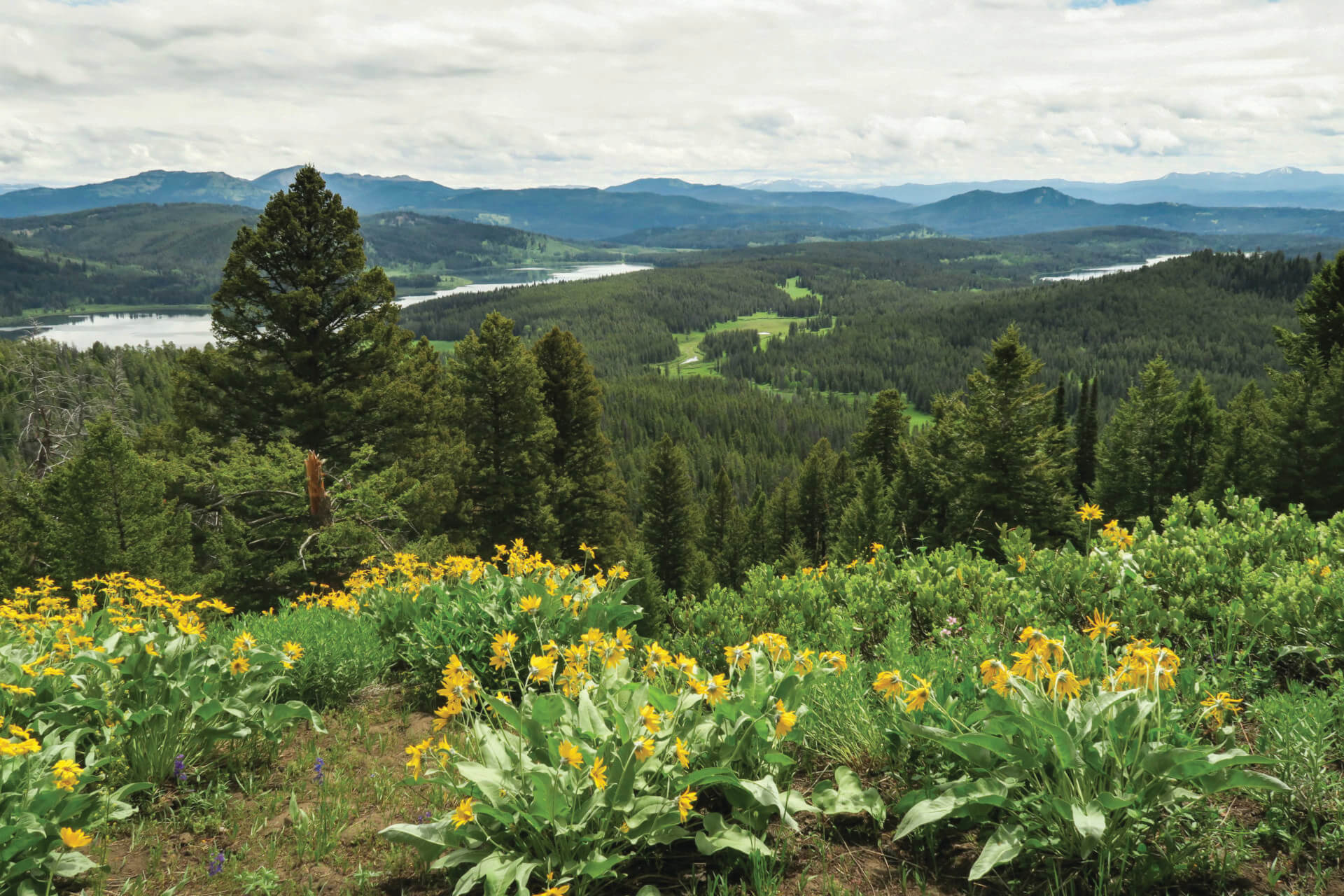
Although Grand View Point lies within Grand Teton National Park, it is not part of the Teton Range—which is why it really delivers on its name. About 10 miles east of the peaks, the 7,286-foot summit looks out on an expansive panorama of the entire range: Nez Perce, the Grand, Teewinot, Owen, Mt. Moran, and points north. Few other spots at similar elevation offer more sweeping views. You can also see Jackson, Emma Matilda and Two Ocean Lakes and the Gros Ventre Range. Hike here early in summer, and you’ll cross hillsides bright with sunshine-yellow arrowleaf balsamroot.
Starting at the Grandview Point Trailhead, it’s a 2.6-mile round-trip hike with about 740 feet of elevation gain. You can also start from Jackson Lake Lodge for a longer route that totals 5.8 miles round-trip with about 920 feet of elevation gain.
For an even longer outing, park at the Two Ocean Lake Trailhead and include Grand View Point as a spur on a loop around Two Ocean Lake. At 8.5 miles, this is a substantial hike but well worth the effort. Despite its name, the lake does not drain into two oceans (unlike nearby Two Ocean Pass, where waters do ultimately split between the Atlantic and Pacific); Two Ocean Lake drains only into the Pacific. Along the lake’s northern shore, the Tetons dominate the western horizon. The trail occasionally passes through stands of pine and aspen, but is mostly open, with unobstructed views across the lake to the range. Both Grand View Point and Two Ocean Lake are prime bear habitat; carry bear spray and know how to use it.
To reach the Two Ocean Lake Trailhead, travel one mile north on the Park Road from the Moran entrance, turn northeast onto Pacific Creek Road for two miles, then north onto the dirt Two Ocean Lake Road for 2.5 miles to its end. For the Grand View Point Trailhead, drive two miles north from Jackson Lake Junction, turn east on an unmarked dirt road, and continue one mile to the end.
Known | National Museum of Wildlife Art
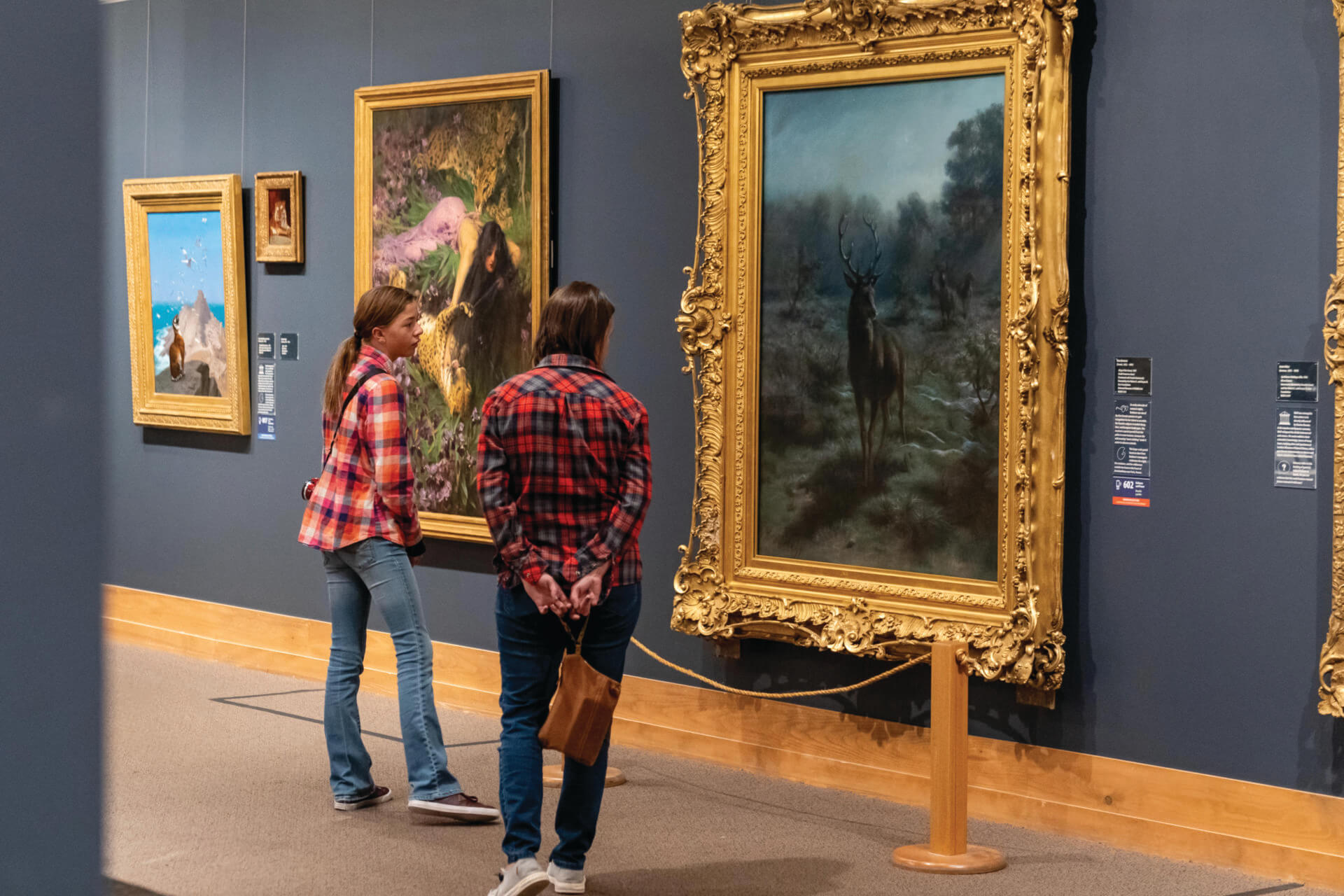
Tucked into the hillside three miles north of Jackson’s Town Square, the National Museum of Wildlife Art blends so seamlessly into its setting that it’s easy to miss. The driveway is marked only by five bronze elk and an understated sign, and the building itself—clad in camouflaging Idaho quartzite and inspired by the ruins of Slains Castle in Aberdeenshire, Scotland—seems part of the landscape. But turn onto Rungius Drive and climb the hill, and you arrive at a national treasure. In 2008, Congress officially designated it the “National Museum of Wildlife Art of the United States,” and today, on the eve of its 40th anniversary, it remains the country’s only museum devoted entirely to wildlife art.
Founded in 1987, the 51,000-square-foot museum includes 14 galleries, a restaurant (Palate), and a research library. Its permanent collection of more than 5,000 works spans roughly 4,500 years, from about 2500 BCE to the present, and reflects a broad definition of wildlife art. Canonical wildlife painters are well represented: Carl Rungius, Richard Friese, Wilhelm Kuhnert, and Bruno Liljefors all hang here. So do works by Rosa Bonheur—one of the few 19th-century women artists to achieve significant recognition in her lifetime, collected by Queen Victoria and the first woman awarded the Chevalier of the Légion d’Honneur—as well as Georgia O’Keeffe, Andy Warhol, and Pablo Picasso. Outside, an almost mile-long sculpture trail overlooking the National Elk Refuge is free to explore.
Underappreciated | Native American Artists and Artifacts
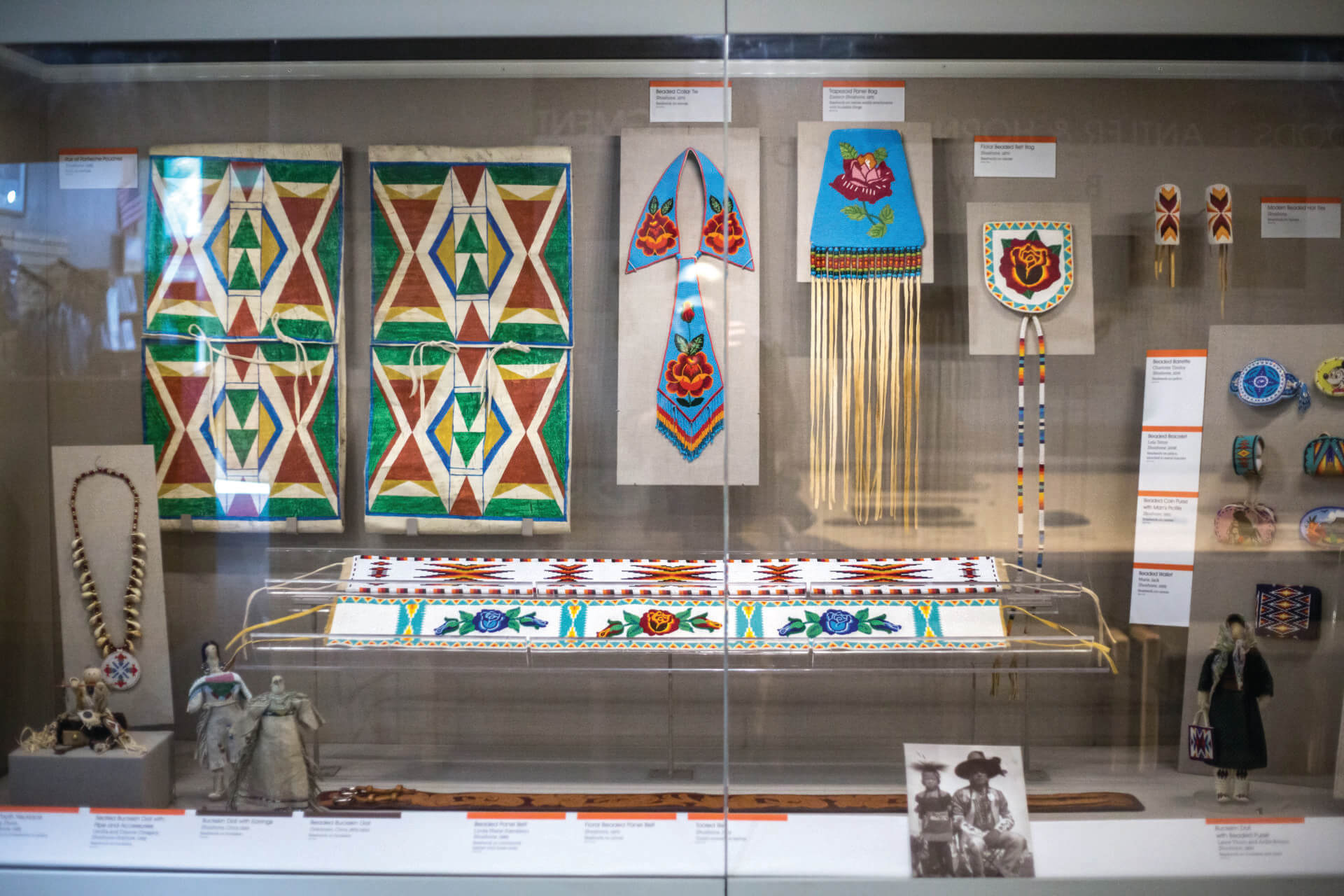
Humans have used the land that is now Grand Teton National Park for at least 11,000 years. Twenty-four Native American tribes—from the Apache Tribe of Oklahoma to the Eastern Shoshone and Northern Arapaho tribes of the Wind River Reservation in Wyoming, and the Shoshone-Bannock Tribes of the Fort Hall Reservation in Idaho—maintain cultural ties to the park.
For four decades, Grand Teton was home to the Colter Bay Indian Arts Museum, which displayed the David T. Vernon Collection, a world-class assemblage of art and artifacts from about 100 tribes. The museum closed in 2011 so that the collection—half of which had been on continuous display since 1972—could undergo conservation at the Western Archaeological Conservation Center in Arizona. That meticulous work was completed in 2020, but to ensure the collection’s long-term preservation, only about 100 items at a time are now displayed at the Craig Thomas Discovery and Visitor Center in Moose and the Colter Bay Visitor Center; the remainder is kept in storage.
Colter Bay also hosts the long-running Indigenous Arts and Cultural Demonstration Program. A partnership between the park and the Grand Teton Association, it brings Native artists for weeklong residencies from late May through mid-September to demonstrate, discuss, and sell their work. Guest artists work in a range of media, from beadwork to oil painting and photography.
The Craig Thomas Discovery and Visitor Center sits just before the Moose entrance to the park. The Colter Bay Visitor Center is in Colter Bay Village, six miles north of Jackson Lake Lodge. JH